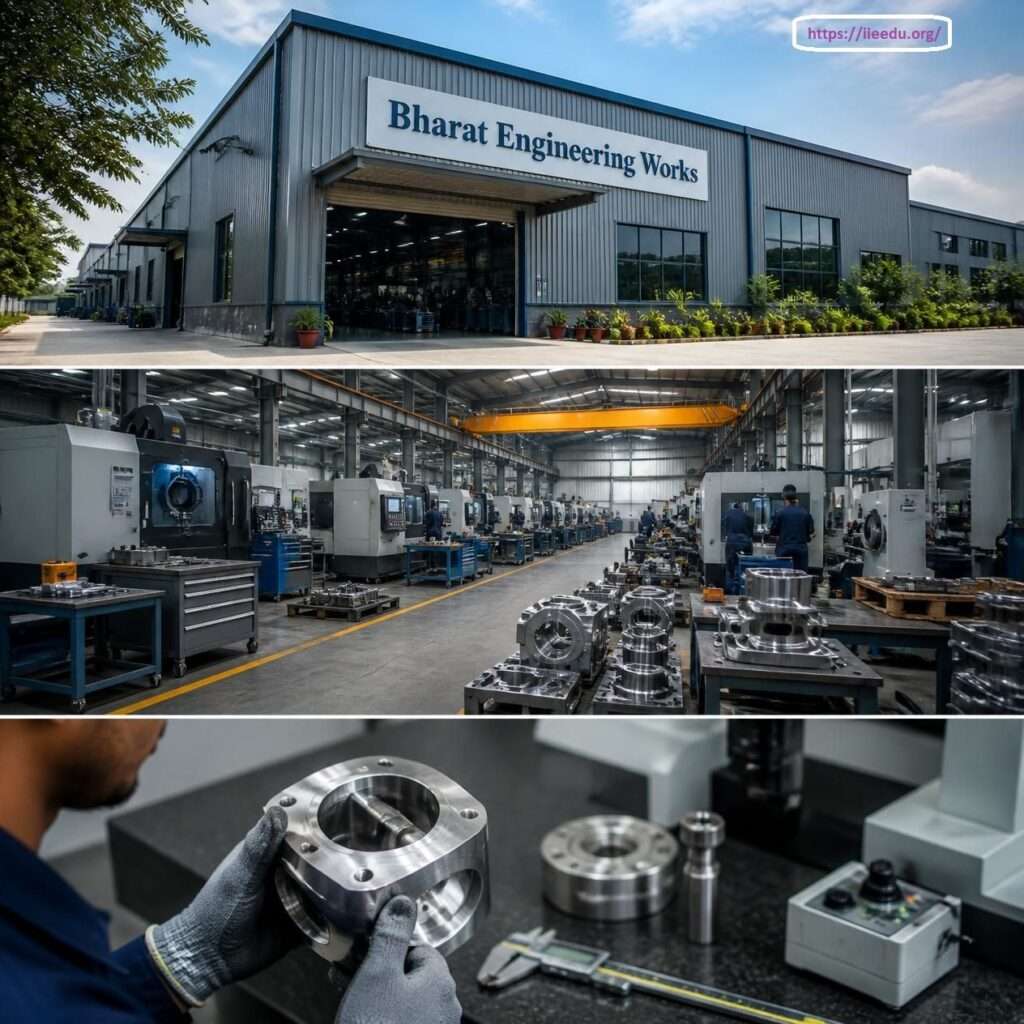
Bharat Engineering Works
- Bharat Engineering Works
- Chapter 1 The Foundation of an Engineering Vision
- Chapter 2 The Decision to Pursue ISO 9001:2008
- Chapter 3 Transforming Daily Work Into a Quality System
- Chapter 4 Building Customer Confidence Through Consistency
- Chapter 5 Strengthening Operations and the People Behind the Process
- Chapter 6 From Quality Control to Continuous Improvement
- Chapter 7 Strengthening Supplier Relationships and Material Control
- Chapter 8 Expanding Opportunities Through a Stronger Reputation
- Chapter 9 Operational Efficiency and the Road to Sustainable Growth
- Chapter 10 The Legacy of Certification and the Road Ahead
- Take the Next Step Today

Chapter 1 The Foundation of an Engineering Vision
Every successful engineering company begins with a vision. Sometimes that vision starts with a large investment, advanced machinery and a carefully designed business plan. At other times, it begins with something much simpler—a strong understanding of engineering work, a commitment to customers and the determination to build a business through hard work and reliability.
The story of Bharat Engineering Works belongs to the second kind.
Located at 205, Kamaldeep Industrial Estate, Sonawala Cross Road No. 2, 2nd Floor, Goregaon (E), Mumbai – 400063, the company developed its identity around engineering and fabrication activities. Its scope of work included the manufacture and supply of instrument tubes, pipe fittings, engineering and fabrication works. These were areas where accuracy, workmanship, technical understanding and customer confidence played an important role.
In the early phase of the company’s development, business was driven largely by practical experience. Engineering work was understood not merely through books or drawings but through years of hands-on learning. Every order presented a different requirement. Every customer had different expectations. Every fabrication job demanded attention to dimensions, materials, workmanship and delivery.
The people associated with Bharat Engineering Works understood that engineering was an industry where small details could have significant consequences.
A tube had to be manufactured according to the required dimensions. A pipe fitting had to meet the expected specifications. A fabricated component had to be properly prepared and completed. Materials had to be suitable for the intended application. Measurements had to be checked carefully. Communication with customers had to be clear.
The company gradually built its reputation through this practical approach.
At the center of this journey was the promoter, whose vision extended beyond simply completing individual orders. The promoter wanted Bharat Engineering Works to become a dependable engineering organization—one that customers could approach with confidence when they needed manufacturing, supply or fabrication support.
However, building a dependable organization required more than technical skill.
As business activities increased, the company began to encounter the natural challenges faced by growing engineering enterprises. More enquiries meant more quotations. More orders meant greater coordination. Different customers brought different specifications. Materials had to be arranged according to requirements. Production activities had to be coordinated. Inspection became increasingly important. Documentation had to be maintained.
The company began realizing that the methods that worked when operations were smaller could become difficult to manage as the organization grew.
Experience was valuable, but experience alone could not always provide consistency.
A skilled employee might know exactly how a particular activity should be performed. But what would happen if another employee had to perform the same activity? Could the knowledge be transferred? Could the process be repeated in the same way? Could the company demonstrate to a customer how quality was being controlled?
These questions gradually became more important.
The promoter understood that the future of Bharat Engineering Works depended on converting individual experience into organizational capability.
This was the beginning of a new way of thinking.
Instead of asking only, “Can we complete this order?”, the organization began asking, “How can we complete this order consistently, efficiently and according to the customer’s requirements?”
The difference between these two questions was significant.
The first focused on completion.
The second focused on a system.
This thinking became especially important as customers became more conscious of quality management. In an increasingly competitive engineering market, customers were not interested only in price. They wanted confidence that their suppliers understood requirements, controlled their processes and could provide consistent products and services.
For Bharat Engineering Works, this represented both a challenge and an opportunity.
The company already had engineering experience. It already had practical knowledge. It already understood fabrication and supply activities. What it needed was a structured framework through which these capabilities could be managed and demonstrated.
The promoter began looking toward quality management certification.
The decision to pursue ISO 9001:2008 was therefore not simply a decision to obtain a certificate. It represented a decision to strengthen the organization itself.
ISO 9001 introduced a systematic approach to areas such as customer requirements, process control, purchasing, production, inspection, documentation, corrective action and continual improvement. For Bharat Engineering Works, these principles provided an opportunity to organize activities that were already taking place and bring them under a more clearly defined management framework.
The transformation would not happen overnight.
Employees would have to understand new responsibilities. Existing practices would have to be examined. Processes would have to be documented. Records would have to be maintained. Management would have to remain involved. Internal audits would have to be conducted. Problems would have to be analyzed instead of simply corrected.
But the promoter believed that the effort would be worthwhile.
The objective was to build a company where quality was not dependent upon one person checking everything.
Instead, quality would become part of the way the organization worked.
This philosophy would eventually influence purchasing, production, inspection, documentation, customer communication and management decision-making.
The journey toward ISO 9001:2008 certification became a turning point.
In 2011, Bharat Engineering Works achieved the important milestone of certification. The certificate, valid through 2014, became an external recognition of the company’s quality management system.
But for the promoter, the certificate represented something deeper.
It represented the beginning of a more organized future.
The company had started with engineering knowledge and determination. Now it was developing systems to support those strengths.
The road ahead would not always be easy. There would be challenges in maintaining documentation, training employees, controlling processes and responding to customer expectations. Yet every challenge would provide another opportunity to improve.
#BharatEngineeringWorks
Chapter 2 The Decision to Pursue ISO 9001:2008
The decision to pursue ISO 9001:2008 certification was not taken as a simple administrative exercise at Bharat Engineering Works. It emerged from a growing realization within the organization that the future of the company depended upon creating a stronger and more systematic way of working.
The company had already developed valuable practical experience in the manufacture and supply of instrument tubes, pipe fittings, engineering and fabrication works. Its people understood the technical side of the business. They knew the importance of dimensions, materials, workmanship, inspection and delivery. Customers had confidence in the company’s ability to complete engineering requirements.
But the business environment was changing.
Customers were becoming more demanding. Engineering buyers increasingly wanted suppliers who could demonstrate not only technical capability but also systematic control over quality. Documentation, traceability, inspection, consistency and customer satisfaction were becoming increasingly important factors in supplier selection.
The promoter of Bharat Engineering Works understood that remaining competitive would require the company to evolve.
One afternoon, during an internal discussion about future business opportunities, the subject of quality certification became particularly important. The discussion was not simply about displaying an ISO certificate in the office. The promoter asked a more fundamental question:
“What would happen if we built the entire organization around a proper quality system?”
The question changed the direction of the discussion.
Instead of viewing ISO 9001 as an external requirement, the company began considering it as a management tool.
The first step was understanding what ISO 9001:2008 actually required.
The management learned that the standard was based on a process-oriented approach. Customer requirements needed to be understood before work was accepted. Processes needed to be defined. Responsibilities needed to be established. Documents and records needed to be controlled. Purchasing needed attention. Production and service activities needed appropriate controls. Inspection and monitoring needed to be performed. Nonconformities needed to be addressed. Corrective action needed to prevent recurring problems. Management needed to review the effectiveness of the system.
For some employees, these concepts appeared to introduce additional work.
They were accustomed to relying on experience.
If an experienced employee knew how to perform a particular task, why was a written procedure necessary?
If a customer had already explained an order verbally, why was documentation important?
If a product was inspected before dispatch, why was process control required?
These questions were natural.
The management therefore emphasized that the objective was not to replace practical knowledge. It was to preserve and strengthen it.
A skilled employee might know exactly how to perform a job. A documented system could ensure that this knowledge became available to the organization rather than remaining only in the employee’s memory.
This became one of the strongest arguments for certification.
The company began reviewing its existing methods.
How were enquiries received?
How were quotations prepared?
How were customer specifications reviewed?
How were purchase requirements communicated to suppliers?
How were incoming materials checked?
How were manufacturing and fabrication activities controlled?
How were inspections recorded?
How were finished products released?
How were customer complaints handled?
How were problems investigated?
The answers revealed areas where the company already had strong practices and other areas where greater formalization could provide benefits.
The next stage was documentation.
Processes had to be described in a way that employees could understand and follow. Forms and records had to be developed where necessary. Responsibilities had to become clearer.
The purpose was not to create unnecessary paperwork.
The purpose was to create evidence and consistency.
For example, if a customer later questioned whether a requirement had been understood correctly, the organization should have information available to demonstrate what had been reviewed.
If a material issue occurred, purchasing records could help identify what had been ordered and from whom.
If a nonconforming product was identified, inspection information could help determine where the issue had occurred.
If the same problem appeared repeatedly, corrective-action records could help management investigate its underlying cause.
Gradually, employees began understanding the practical value of the system.
Training became an important part of the transition.
The company needed people to understand that quality was not the exclusive responsibility of an inspector or quality representative.
The person communicating with the customer affected quality.
The purchaser affected quality.
The person receiving material affected quality.
The production worker affected quality.
The inspector affected quality.
The person preparing dispatch documentation affected quality.
Management itself affected quality through decisions, resources and priorities.
The company therefore began developing a shared understanding that quality was everyone’s responsibility.
Another important change was the way the organization viewed mistakes.
Previously, a problem might simply be corrected so that the order could be completed. Under the developing quality system, the company began asking why the problem had occurred.
If an incorrect dimension was discovered, was the drawing misunderstood?
Was the measurement method appropriate?
Was the instrument accurate?
Was the employee properly trained?
Was the requirement communicated correctly?
The objective was to find the cause rather than simply repair the result.
This approach introduced a new culture of learning.
Problems were no longer viewed only as failures.
They could become opportunities for improvement.
As preparation progressed, the company also recognized the importance of internal auditing. Employees and management needed a way to verify whether the newly established system was actually working.
Internal audits provided that mechanism.
They encouraged the organization to examine its own processes before an external auditor did.
Management review added another dimension.
The promoter and management could examine customer feedback, process performance, nonconformities, corrective actions, resources and improvement opportunities.
This transformed quality from an operational activity into a management responsibility.
The months of preparation required patience.
There were documents to develop.
Employees had to be trained.
Processes had to be understood.
Records had to be maintained.
Existing practices had to be reviewed.
But slowly, the organization began to change.
The company was becoming more structured without losing its engineering identity.
Its practical experience remained the foundation.
ISO 9001 was becoming the framework around that foundation.
Eventually, the effort reached its defining milestone.
In 2011, Bharat Engineering Works achieved ISO 9001:2008 certification, with the certification valid through 2014.
The certificate represented external recognition.
But internally, the company understood that the real achievement was much greater.
The organization had learned to think in terms of processes.
It had begun documenting knowledge.
It had strengthened customer focus.
It had developed a more systematic approach to purchasing, manufacturing and inspection.
It had introduced a stronger mechanism for corrective action.
Most importantly, it had begun building a culture in which quality was connected with every employee and every business activity.
The promoter looked at the certificate with satisfaction, but also with a sense of responsibility.
Certification was not the end.
It was the beginning of a new phase.
The next challenge would be harder: maintaining the system during everyday business pressure and proving that quality management was not simply something prepared for an audit.
#ISO9001
Chapter 3 Transforming Daily Work Into a Quality System
The achievement of ISO 9001:2008 certification in 2011 gave Bharat Engineering Works a new sense of direction. The certificate represented recognition, but the management understood that the real test would begin after certification.
It was easy to place the certificate in the office.
It was much harder to make quality management part of everyday work.
The promoter repeatedly emphasized this point to the team. Certification could create credibility, but only consistent performance could sustain it. The organization therefore began focusing on one important objective: converting the principles of the quality management system into daily habits.
The first area of attention was customer requirements.
In engineering, an order can contain numerous details. A customer may specify dimensions, materials, quantities, drawings, technical requirements, delivery expectations, inspection requirements and documentation. Missing even one important detail could create difficulties later.
Earlier, much of this information might have been handled through conversations, telephone calls, letters or individual experience. The new system encouraged a more structured approach.
Before accepting an order, the company began giving greater importance to understanding exactly what the customer wanted.
Could the requirement be fulfilled?
Were the specifications clear?
Were the drawings available?
Were the required materials obtainable?
Could the requested quantity be manufactured?
Was the expected delivery schedule realistic?
Were there any special inspection or documentation requirements?
These questions helped the company reduce misunderstandings before manufacturing began.
The promoter understood that quality problems often begin before production.
If the customer requirement is misunderstood, even excellent manufacturing cannot produce the correct result.
This simple realization changed the way the company viewed its order process.
The next major area was purchasing.
Instrument tubes, pipe fittings and fabrication activities depended upon suitable materials and components. The quality of incoming material could directly influence the final product.
The company therefore began paying greater attention to supplier selection and purchasing requirements.
Purchase specifications needed to be communicated clearly.
Suppliers needed to understand what was expected.
Materials received from suppliers had to be appropriately checked.
Where applicable, relevant documentation needed to be maintained.
Supplier performance became an important consideration.
The purpose was not to make purchasing unnecessarily complicated. It was to ensure that the organization did not unknowingly introduce quality problems through uncontrolled inputs.
The lesson was straightforward:
A quality product cannot reliably be produced from an uncontrolled input.
The same philosophy extended into production and fabrication.
The shop floor was where drawings, specifications and materials became finished products.
Employees performing engineering and fabrication work possessed valuable practical knowledge. However, the quality system encouraged them to combine that experience with defined processes.
Work had to be properly identified.
Requirements had to be understood.
Measurements had to be controlled.
Inspection stages had to be recognized.
Nonconforming work had to be identified rather than accidentally mixed with conforming products.
These practices gradually created greater consistency.
Employees initially viewed some of the new requirements as additional responsibilities. But with time, many began to recognize their practical value.
A record could answer a question later.
A controlled drawing could prevent an outdated specification from being used.
An inspection record could provide evidence of verification.
A clearly defined responsibility could prevent confusion.
The quality system was becoming less about paperwork and more about organizational memory.
One of the most significant changes involved inspection.
Inspection had always been important to an engineering company. However, the organization began understanding that inspection alone was not enough.
Suppose a component was found to be incorrect during final inspection.
The immediate response might be to correct or replace it.
But the quality system encouraged another question:
Why did the error occur?
Perhaps the drawing was misunderstood.
Perhaps the wrong measurement was taken.
Perhaps the employee lacked adequate instructions.
Perhaps the material was incorrect.
Perhaps the process itself was not sufficiently controlled.
By investigating the cause, the organization could reduce the possibility of repetition.
This introduced a preventive mindset.
Instead of simply finding defects, Bharat Engineering Works began looking for ways to prevent defects.
Corrective action therefore became an important part of the developing quality culture.
When a problem occurred, the objective was not to blame an individual.
The objective was to understand the process.
This approach improved communication between employees.
Workers became more willing to report difficulties.
Supervisors could investigate problems.
Management could make decisions based on information.
The organization was learning to treat problems as opportunities for improvement.
Internal audits further strengthened this approach.
An internal audit provided an opportunity to examine whether procedures were actually being followed.
Were records maintained?
Were responsibilities understood?
Were customer requirements properly reviewed?
Were materials controlled?
Were inspection activities documented?
Were previous corrective actions effective?
Instead of waiting for an external audit to reveal weaknesses, the company could identify and address them internally.
Management review provided another important mechanism.
The promoter and management could step back from individual orders and consider the performance of the organization as a whole.
Customer feedback could be reviewed.
Quality problems could be discussed.
Supplier performance could be evaluated.
Training needs could be considered.
Improvement opportunities could be identified.
This encouraged management to think beyond immediate production.
The company was gradually becoming more strategic.
The ISO system also influenced employee development.
Training was no longer viewed simply as a way to teach technical skills. Employees needed to understand their responsibilities within the quality management system.
A person handling customer information needed to appreciate the importance of accuracy.
A purchaser needed to understand the impact of incorrect material.
A production employee needed to recognize the importance of following defined requirements.
An inspector needed to maintain reliable records.
Every employee had a role in the quality chain.
This understanding helped create a stronger organizational culture.
By the period following certification, Bharat Engineering Works was no longer simply trying to demonstrate that it had a quality system.
It was learning to operate through that system.
The difference was significant.
The certificate had opened the door.
Implementation was teaching the organization how to walk through it.
The promoter could now see that quality management was beginning to influence the company’s identity.
The company was becoming more organized, more process-oriented and more conscious of customer expectations.
But the journey was still at an early stage.
The next challenge would be to use this stronger foundation not merely to maintain existing business, but to build greater customer confidence and create new opportunities for growth.
#QualityManagement
Chapter 4 Building Customer Confidence Through Consistency

After obtaining ISO 9001:2008 certification in 2011, Bharat Engineering Works entered a new phase of its development. The company had established a formal quality management system, but the promoter understood that certification alone would not create long-term growth.
The real opportunity was to turn the new system into customer confidence.
For an engineering organization involved in the manufacture and supply of instrument tubes, pipe fittings, engineering and fabrication works, trust was one of the most valuable assets. Customers needed to believe that the company could understand their requirements, manufacture or supply the required products correctly and respond responsibly when challenges appeared.
The promoter therefore began encouraging the team to look at every order from the customer’s perspective.
A customer did not see the internal procedures.
The customer saw the quotation.
The customer saw the communication.
The customer saw the product.
The customer experienced the delivery.
The customer reviewed the documentation.
And if something went wrong, the customer judged the company’s response.
This realization changed the way the organization viewed quality.
Quality was no longer considered only an internal matter.
It was directly connected with the company’s reputation.
The first major change was in communication.
Before certification, information could sometimes be dependent upon individual conversations. After implementation of the quality system, the organization became more conscious of recording and controlling important customer requirements.
When a new enquiry arrived, the team was encouraged to understand the requirement carefully.
What exactly was the customer asking for?
What quantity was required?
Were dimensions specified?
Were material requirements clear?
Were drawings available?
Was there a delivery commitment?
Were there inspection requirements?
Were there special instructions?
This approach reduced ambiguity.
The promoter explained that every unanswered question before production could potentially become a problem after production.
It was better to spend time understanding a requirement at the beginning than to spend much more time correcting a mistake later.
This philosophy gradually became part of the company’s working culture.
The same attention was given to quotations.
A quotation was no longer viewed merely as a commercial offer.
It represented a commitment.
If the company promised a certain product, specification or delivery schedule, the organization needed to ensure that it had the capability and resources to meet that commitment.
This encouraged greater coordination between commercial and technical activities.
The sales side needed to communicate accurately.
The technical side needed to review feasibility.
Purchasing needed to understand material requirements.
Production needed to understand what had been promised.
Inspection needed to know what had to be verified.
The customer therefore became the connecting point between different activities.
This process strengthened internal teamwork.
Another important change involved handling customer complaints.
In the past, a complaint might naturally create pressure. Employees could feel defensive because they believed that a complaint meant someone had failed.
The quality management approach encouraged a different response.
A complaint was information.
It indicated that something had not met expectations.
The company could investigate the issue.
What happened?
What requirement was involved?
Where did the problem originate?
Was it an isolated incident?
Could it happen again?
What corrective action was necessary?
This approach changed the atmosphere around complaints.
Instead of asking, “Who is responsible?”, the organization increasingly asked, “What happened in the process?”
This distinction was important.
If the root cause was a communication problem, communication needed improvement.
If the cause was inadequate inspection, inspection needed strengthening.
If the problem involved material, purchasing controls needed review.
If training was insufficient, employee competence needed attention.
The objective was to make the organization stronger after every significant problem.
This was how continual improvement began to take practical meaning.
The company’s ISO certification also became an important part of its professional identity when dealing with prospective customers.
When customers evaluated suppliers, they could see that Bharat Engineering Works had an ISO 9001:2008-certified quality management system.
The certification did not replace technical capability.
Instead, it supported the company’s technical reputation.
The message was simple:
“We do not depend only on experience; we have also established a system for managing quality.”
This could be particularly valuable when approaching organizations that expected their suppliers to demonstrate formal quality practices.
The promoter understood that certification could open doors, but performance would determine whether those doors remained open.
Therefore, the company continued focusing on consistency.
If one customer received excellent service but another experienced poor communication, the reputation of the company could still suffer.
Consistency became the goal.
Every customer deserved attention.
Every order deserved proper review.
Every product needed to meet applicable requirements.
Every complaint needed to be taken seriously.
Every employee had a role in protecting the company’s reputation.
The quality system also helped employees understand the connection between their individual work and customer satisfaction.
A purchaser might never meet the customer, but an incorrect material could affect the customer.
A production worker might never speak with the customer, but poor workmanship could affect the customer’s confidence.
An inspector might not participate in commercial negotiations, but inspection accuracy could determine whether the final product was accepted.
An administrative employee might not manufacture anything, but incorrect documentation could create confusion.
Everyone was part of the customer experience.
This understanding helped create a stronger sense of responsibility.
As time passed, the company began to see that customer confidence could become a source of growth.
A satisfied customer could return.
A reliable supplier could receive repeat enquiries.
A company that handled problems professionally could preserve relationships.
A company known for consistent quality could gain recommendations.
Growth therefore did not have to come only from aggressive sales.
It could also come from reputation.
The promoter increasingly believed that the best marketing for an engineering organization was dependable performance.
A certificate could attract attention.
A good product could create satisfaction.
Consistent service could create loyalty.
Loyalty could create long-term business.
This became one of the important lessons of the post-certification period.
Bharat Engineering Works was gradually building something more valuable than a certificate.
It was building trust.
The transformation was not dramatic from one day to the next. It occurred through routine activities—reviewing requirements, controlling materials, checking products, maintaining records, responding to customers and learning from mistakes.
But these small actions accumulated.
The company was becoming more disciplined.
Customers were gaining greater confidence.
Employees were understanding their responsibilities.
Management was beginning to see quality as part of business strategy.
The ISO certification had therefore begun to produce a broader impact.
It was helping Bharat Engineering Works strengthen the relationship between quality, reputation and growth.
The next stage would require the company to look beyond internal processes and explore how improved quality could support stronger market opportunities, better supplier relationships and broader business development.
#EngineeringExcellence
Chapter 5 Strengthening Operations and the People Behind the Process
Courtesy: Bharat Engineering Works
As Bharat Engineering Works moved forward after achieving ISO 9001:2008 certification in 2011, the promoter began to recognize that a quality management system could only become successful when it was supported by capable and committed people.
Documents could define processes.
Procedures could explain responsibilities.
Records could provide evidence.
Audits could identify weaknesses.
But people had to make the system work.
For an engineering organization involved in the manufacture and supply of instrument tubes, pipe fittings, engineering and fabrication works, this human element was particularly important. Machines and tools could support production, but technical judgment, workmanship, attention to detail and experience remained essential.
The promoter therefore began focusing more strongly on the people working within Bharat Engineering Works.
One of the first lessons was that employees needed to understand why processes were changing.
If workers were simply told to complete forms or follow new procedures, they might see the ISO system as additional paperwork.
But if they understood that the system was designed to reduce errors, clarify responsibilities and improve customer satisfaction, the purpose became clearer.
Training discussions therefore became an important part of the company’s development.
Employees were introduced to the basic principles of quality management.
They learned about customer requirements.
They learned why documentation mattered.
They learned why materials needed proper control.
They learned the importance of inspection.
They learned how nonconforming work should be identified.
They learned that corrective action was not about blaming individuals.
Most importantly, they learned that quality was not the responsibility of one department.
It belonged to everyone.
A production worker could influence quality.
A purchaser could influence quality.
An inspector could influence quality.
A person communicating with a customer could influence quality.
Even the person responsible for maintaining records could influence quality.
The organization therefore began developing a culture of shared responsibility.
This cultural change was gradual.
People needed time to adjust.
Some employees were comfortable with established working methods and initially wondered why procedures needed to be documented.
The promoter understood this concern.
He did not want to destroy the practical culture that had helped build the company.
Instead, he wanted to combine practical experience with systematic management.
The message to employees was simple:
“The system is here to support your experience, not replace it.”
This approach helped reduce resistance.
Experienced employees began contributing their knowledge to procedures and work practices.
Their practical understanding became part of the company’s documented knowledge.
This was especially valuable because engineering work often depends upon knowledge accumulated through experience.
A senior employee may know how a particular fabrication challenge should be approached.
Another employee may know which inspection point deserves special attention.
A purchaser may understand which supplier has consistently provided suitable materials.
A technician may know how a recurring production issue can be prevented.
The ISO system created an opportunity to capture such knowledge.
The company also began paying greater attention to competence.
It was not enough for a person to be assigned a responsibility.
The person needed to be capable of performing that responsibility.
This encouraged management to think about training requirements more systematically.
Where employees needed additional knowledge, training could be considered.
Where new responsibilities were introduced, competence could be reviewed.
Where errors indicated a knowledge gap, training could become part of the corrective action.
This created a connection between employee development and quality improvement.
At the same time, operational discipline became increasingly important.
Production activities needed planning.
Materials needed identification.
Documents needed control.
Inspection requirements needed to be understood.
Completed work needed appropriate verification.
Records needed to be maintained.
These activities created a more organized workflow.
Instead of relying entirely on memory or verbal instructions, employees could refer to established information.
This reduced the risk of misunderstandings.
It also helped the company become less dependent upon individual employees.
If one person was unavailable, another person could understand the process through documented information.
This was particularly valuable for a growing organization.
As Bharat Engineering Works developed, the promoter understood that a company could not remain dependent upon one person personally supervising every activity.
Growth required delegation.
Delegation required trust.
Trust required systems.
The ISO framework helped establish those systems.
Another area of improvement was communication between different functions.
Before formal process thinking, departments or individuals could sometimes focus primarily on their own responsibilities.
Purchasing focused on obtaining material.
Production focused on manufacturing.
Inspection focused on checking.
Administration focused on documentation.
But quality management showed that these activities were interconnected.
If purchasing received incomplete information, the wrong material could be ordered.
If production did not receive the correct requirement, the wrong product could be manufactured.
If inspection did not understand the specification, a defect could be missed.
If documentation was incomplete, the customer could receive insufficient information.
Therefore, communication became a quality issue.
The promoter encouraged employees to communicate before problems occurred.
Questions were better asked early.
Unclear requirements were better clarified before production.
Potential problems were better reported rather than hidden.
This helped create a more open working environment.
The organization also became more comfortable with internal audits.
Employees initially might have viewed an audit as an inspection of their work.
Over time, the purpose became clearer.
An internal audit was not intended to find someone to blame.
It was intended to identify weaknesses in the system.
If a record was missing, the company could improve the process.
If an instruction was unclear, it could be revised.
If employees were uncertain about responsibilities, roles could be clarified.
If a corrective action was ineffective, another solution could be considered.
This encouraged continuous learning.
The promoter realized that one of the most valuable outcomes of the ISO journey was the development of a habit of questioning.
Employees began asking:
“Is there a better way?”
That question was more important than any individual procedure.
It represented the beginning of continual improvement.
As the organization became more structured, employees also began experiencing the benefits.
Work responsibilities became clearer.
Customer requirements became easier to understand.
Records made information easier to retrieve.
Problems could be investigated more systematically.
Training needs could be identified.
Management could provide clearer direction.
The company was becoming stronger from within.
The transformation of Bharat Engineering Works was therefore not simply a transformation of documents and procedures.
It was a transformation of people.
The promoter’s vision was gradually becoming a shared organizational vision.
The company had begun with technical expertise and practical experience.
Now it was developing competence, accountability and process discipline around those strengths.
This would become an important foundation for the next stage of growth.
Because a company can purchase machines.
It can prepare procedures.
It can obtain certification.
But sustainable growth ultimately depends upon people who understand the organization’s purpose and are willing to deliver quality consistently.
At Bharat Engineering Works, that understanding was beginning to take root.
The certificate had created a framework.
The employees were turning that framework into a working culture.
#ContinuousImprovement
Chapter 6 From Quality Control to Continuous Improvement
After ISO 9001:2008 certification became part of Bharat Engineering Works’ operating framework, the company began to understand an important distinction: quality control and quality improvement were not the same thing.
Quality control focused on identifying whether the product met the required specification.
Quality improvement asked a deeper question:
“How can we make the process better so that problems are less likely to occur?”
This change in thinking became one of the most important developments in the company’s post-certification journey.
For an organization involved in the manufacture and supply of instrument tubes, pipe fittings, engineering and fabrication works, inspection remained essential. Dimensions had to be checked. Materials had to be verified where applicable. Fabrication had to be examined. Finished products needed to be evaluated before delivery.
But management began realizing that inspection at the end of a process could not compensate for weaknesses at the beginning.
If the wrong material entered production, final inspection might discover the problem, but resources had already been consumed.
If a drawing was misunderstood, inspection could identify the resulting error, but production time would already have been lost.
If a customer requirement was unclear, correcting the finished product could be much more expensive than clarifying the requirement before manufacturing began.
The organization therefore began moving toward prevention.
The promoter encouraged employees to think about quality from the beginning of every order.
The first question was no longer simply:
“How will we inspect this?”
It became:
“How will we ensure that this is done correctly?”
That subtle change influenced many activities.
Customer requirements were reviewed more carefully.
Purchasing information became clearer.
Material control received greater attention.
Production instructions became more systematic.
Inspection points were considered during planning.
Records were maintained so that information could be retrieved when needed.
These practices gradually reduced dependence on final inspection alone.
Another important development was the company’s approach to nonconformities.
A nonconformity could occur for many reasons.
Perhaps a dimension did not match the requirement.
Perhaps the wrong material had been received.
Perhaps a fabrication activity had not been completed according to the specified requirement.
Perhaps documentation was incomplete.
Whatever the reason, the organization needed to decide what to do next.
The first responsibility was to prevent the nonconforming output from being unintentionally passed to the customer.
But the company also needed to understand why the problem had occurred.
This encouraged a more analytical culture.
Instead of immediately asking who had made the mistake, management could ask:
What requirement was involved?
At which stage did the problem occur?
Was the information clear?
Was the employee trained?
Was the process adequate?
Was the inspection method effective?
Was the supplier involved?
Could the same problem happen again?
These questions encouraged employees to think in terms of causes rather than symptoms.
Corrective action became an important management tool.
If a recurring issue was identified, the organization could take steps to address the underlying cause.
For example, if a communication gap repeatedly created confusion, the communication process could be strengthened.
If employees were uncertain about a particular requirement, training could be arranged.
If a supplier repeatedly failed to meet expectations, supplier performance could be reviewed.
If a procedure was difficult to understand, it could be clarified.
This created a continuous cycle of learning.
Problem.
Investigation.
Correction.
Corrective action.
Verification.
Improvement.
The company began recognizing that every problem contained information.
This was a powerful cultural change.
Instead of hiding mistakes, employees could report them.
Instead of fearing every nonconformity, employees could understand that identifying a problem early was better than allowing it to reach the customer.
This encouraged greater transparency.
The promoter reinforced this philosophy.
A problem discovered internally was an opportunity to improve.
A problem discovered by a customer was a warning that the internal system needed attention.
The objective was therefore to create an environment where employees felt comfortable bringing problems forward.
This was not always easy.
People naturally worry that admitting an error may result in criticism.
Management therefore had to distinguish between negligence and genuine process problems.
If an employee deliberately ignored a requirement, accountability was necessary.
But if the process itself was unclear, blaming the employee would not solve the problem.
The company increasingly focused on improving the system.
Internal audits became particularly useful in this regard.
An internal audit could reveal that a procedure existed but was not understood.
It could identify missing records.
It could show that a responsibility was unclear.
It could highlight a recurring issue.
It could also confirm that a process was working effectively.
The audit therefore became a source of information.
Management could use audit findings to prioritize improvement activities.
Another important element was customer feedback.
Customers could provide information that internal employees might not notice.
A customer might identify a documentation problem.
A delivery issue might reveal a planning weakness.
A technical query might reveal that the company’s communication needed improvement.
A complaint might reveal a process weakness.
The company began viewing feedback as an input into continual improvement.
The promoter also understood that improvement did not always require major investment.
Sometimes a simple change could produce a significant benefit.
A clearer form could reduce confusion.
A better sequence of activities could reduce waiting.
A clearer identification method could prevent mix-ups.
A short training session could eliminate repeated mistakes.
A more structured review could prevent an incorrect order from entering production.
Continuous improvement was therefore not necessarily about expensive technology.
It was about better thinking.
This philosophy also influenced management review.
Instead of treating management review as a formal meeting required only for certification purposes, the company could use it to discuss actual business performance.
What problems were recurring?
What were customers saying?
Which suppliers required attention?
Where was rework occurring?
What training was needed?
Which processes were working well?
Where could resources be improved?
These questions connected quality management with business management.
The company was gradually moving toward a more mature understanding of ISO 9001.
The standard was not merely asking for documents.
It was encouraging the organization to manage its processes, evaluate results and improve performance.
For Bharat Engineering Works, this was especially important because growth would inevitably bring greater complexity.
More orders could mean more opportunities for errors.
More customers could mean more varied requirements.
More suppliers could mean more purchasing risks.
More employees could mean greater communication challenges.
A stronger improvement culture would help the company handle that complexity.
By this stage, the organization had begun moving beyond the question of whether it had a quality management system.
The more important question had become:
“Is our quality management system making us better?”
That question represented a major step forward.
The company was learning that quality was not a destination reached through certification.
It was a continuous journey.
Every order provided a lesson.
Every customer interaction provided information.
Every audit provided an opportunity.
Every nonconformity provided a warning.
Every successful improvement strengthened the organization.
Bharat Engineering Works had started its ISO journey by seeking a structured way to manage quality.
#CustomerSatisfaction
Chapter 7 Strengthening Supplier Relationships and Material Control
As Bharat Engineering Works continued implementing the principles of ISO 9001:2008, management discovered that one of the most important factors influencing final product quality was often outside the company’s immediate production area.
It was the supply chain.
The company manufactured and supplied instrument tubes, pipe fittings and carried out engineering and fabrication works. These activities depended upon materials, components, consumables, tools and services obtained from external suppliers. If an incoming material did not meet the required specification, the production process could be affected before manufacturing even began.
The promoter therefore encouraged the team to look at purchasing from a quality perspective.
Previously, purchasing could naturally be viewed as a commercial activity—finding the required material at an acceptable price and arranging delivery.
The quality management approach introduced another question:
“Is the supplier capable of consistently providing what we require?”
This question changed the way supplier relationships were viewed.
Price remained important. Delivery remained important. But quality and reliability also became significant.
The company began paying greater attention to the information communicated to suppliers.
A vague purchase requirement could result in an incorrect material.
A missing specification could create confusion.
An incomplete description could lead to assumptions.
Therefore, purchasing information needed to be sufficiently clear for the supplier to understand what was expected.
This was particularly important for engineering products.
Materials used for instrument tubes, pipe fittings and fabrication activities could have specific requirements. Depending on the customer’s order, factors such as dimensions, material type, quantity and applicable technical requirements could become important.
The purchasing team therefore became more conscious of accuracy.
A purchase order was not merely a request to send material.
It was a communication of requirements.
The company also began giving greater attention to incoming material.
When material arrived, it needed to be appropriately identified and checked according to the organization’s requirements.
Was the material what had been ordered?
Was the quantity correct?
Was the condition acceptable?
Were relevant documents available where required?
Could the material be identified and controlled during its use?
These questions helped reduce the possibility of unsuitable inputs entering production.
The objective was not to create unnecessary delays.
It was to prevent a larger problem later.
The promoter often reminded employees that discovering a problem before production was much better than discovering it after a finished product had been manufactured.
An incoming material issue could be isolated.
A production-stage issue could require rework.
A customer-stage issue could affect reputation.
The earlier a problem was identified, the easier it was generally to manage.
Supplier performance also became an area of attention.
A supplier might provide good material once, but the organization needed confidence in consistent performance.
Was the supplier delivering on time?
Was the supplied material consistently acceptable?
Did the supplier respond quickly when questions arose?
Were problems corrected effectively?
Was documentation provided appropriately?
These considerations helped Bharat Engineering Works develop a more systematic approach to supplier evaluation.
The company did not want supplier relationships to become purely transactional.
Good suppliers were valuable partners.
A reliable supplier could support production planning, reduce uncertainty and contribute to customer satisfaction.
The organization therefore learned that supplier management was not about finding faults with suppliers.
It was about developing a dependable supply chain.
Communication became central to this process.
When a supplier performed well, the company could continue building the relationship.
When a problem occurred, the supplier could be informed and the issue investigated.
If necessary, corrective action could be requested.
If the problem was repeated, management could review the supplier’s suitability.
This created accountability on both sides.
The supplier understood that Bharat Engineering Works expected consistent quality.
The company understood that it also needed to communicate requirements clearly.
This two-way responsibility strengthened relationships.
Another important lesson involved material identification.
In an engineering environment, different materials or components may appear similar even though their specifications are different.
Mixing materials can create serious problems.
The quality system therefore encouraged better control of identification and status wherever necessary.
Employees needed to know which material was approved for use, which material was awaiting verification and which material had been rejected or required further action.
This simple discipline reduced confusion.
It also helped maintain traceability where applicable.
Storage practices received greater attention as well.
Materials needed to be protected from conditions that could damage their quality.
Employees became more conscious that quality could deteriorate after material entered the premises if it was not handled appropriately.
The same principle applied to finished products.
Once manufactured or fabricated, products needed to be protected until they reached the customer.
Packaging, handling and dispatch therefore became connected with quality.
The company began to understand that quality did not stop at the production machine.
It continued until the product was delivered.
This broader view was an important benefit of the ISO approach.
Quality became a chain.
Customer requirement was one link.
Purchasing was another.
Supplier performance was another.
Incoming inspection was another.
Production was another.
Final inspection was another.
Packing and dispatch were additional links.
Customer feedback completed the cycle.
If one link became weak, the entire chain could be affected.
The promoter therefore encouraged employees to avoid thinking about their departments in isolation.
Purchasing could not say, “Our job ends when the material arrives.”
Production could not say, “Our responsibility ends when the product leaves the shop floor.”
Inspection could not say, “Our job is only to find defects.”
Everyone was part of the same quality process.
This philosophy improved communication between purchasing and production.
Production employees could communicate recurring material issues.
Purchasing employees could communicate supplier concerns.
Inspection personnel could provide information about incoming material quality.
Management could review supplier performance.
The organization was developing a more connected operating system.
Over time, these improvements also supported customer confidence.
When customers received products that consistently met requirements, the company benefited.
When delivery schedules became more predictable, confidence increased.
When documentation was available, communication became easier.
When supplier problems were handled internally before affecting customers, the company’s reputation was protected.
The promoter understood that customers rarely saw the company’s purchasing procedures.
They did not see supplier evaluations.
They did not see incoming inspection records.
They did not see internal discussions.
But they experienced the results.
That was the true purpose of supplier control.
It was not paperwork for the sake of paperwork.
It was about protecting the final customer.
As Bharat Engineering Works continued its post-certification journey, supplier management became an important component of its operational maturity.
The company was learning that quality was created through a network of relationships.
Its suppliers were part of that network.
By strengthening communication, material control and supplier evaluation, Bharat Engineering Works created a stronger foundation for consistent production.
This improvement would become particularly valuable as the company sought to increase its business opportunities.
A growing company needed reliable suppliers.
Reliable suppliers supported reliable production.
Reliable production supported reliable delivery.
Reliable delivery supported customer satisfaction.
And customer satisfaction supported long-term growth.
The lesson was clear.
A company’s quality is influenced not only by what happens inside its factory or workshop, but also by the quality of the relationships it builds outside it.
Bharat Engineering Works was beginning to understand this principle deeply.
Its ISO journey was transforming the company from a collection of individual activities into an interconnected quality system.
#OperationalExcellence
Chapter 8 Expanding Opportunities Through a Stronger Reputation
Courtesy: Bharat Engineering Works
By the time Bharat Engineering Works had become comfortable with the discipline of its ISO 9001:2008 quality management system, a noticeable change had begun to take place within the organization.
The certificate was no longer simply displayed as evidence of compliance.
It had become part of the company’s professional identity.
The promoter began to see that the real value of certification was not the document itself, but the confidence it could create among customers, employees and business partners.
For an engineering company involved in the manufacture and supply of instrument tubes, pipe fittings, engineering and fabrication works, reputation was particularly important.
A customer placing an engineering order was not simply buying a product.
The customer was placing trust in the supplier’s technical understanding, workmanship, reliability and ability to meet agreed requirements.
Bharat Engineering Works wanted to strengthen that trust.
The promoter therefore began encouraging the team to view every completed order as an opportunity to strengthen the company’s reputation.
A successful order could lead to another enquiry.
A satisfied customer could recommend the company.
A well-managed project could become evidence of capability.
A professionally prepared quotation could create confidence before an order was even placed.
The company’s ISO certification became one part of this communication.
When prospective customers asked about the organization’s quality practices, Bharat Engineering Works could demonstrate that it had established a formal quality management system based on ISO 9001:2008.
This was particularly useful when dealing with customers who wanted greater assurance from their suppliers.
The promoter understood, however, that certification alone could never win long-term business.
A certificate might create an opportunity.
Performance would determine whether the opportunity became a relationship.
Therefore, the company continued focusing on consistency.
Customer requirements were reviewed carefully.
Orders were planned.
Materials were controlled.
Production activities were monitored.
Inspection was performed.
Records were maintained.
Products were prepared for delivery.
Customer feedback was considered.
This systematic approach helped the company present itself with greater confidence.
The transformation also affected the way employees viewed their own organization.
Earlier, employees might have thought primarily about completing their assigned work.
After certification, they increasingly began to understand the larger business objective.
Their work contributed to the reputation of Bharat Engineering Works.
If a purchaser selected the wrong material, the customer’s experience could be affected.
If a production worker ignored a specification, the customer’s confidence could be damaged.
If an inspector missed a problem, the company could face a complaint.
If an administrative employee communicated incorrect information, the customer could become confused.
Everyone therefore had a role in protecting the company’s reputation.
This realization strengthened employee ownership.
The promoter also began thinking about market opportunities.
The engineering sector was becoming increasingly competitive. Companies were expected to demonstrate not only technical capability but also professional management.
ISO certification could help Bharat Engineering Works communicate that it was serious about quality.
This could be particularly valuable when approaching organizations that had formal supplier evaluation systems.
Instead of simply saying, “We have experience,” the company could communicate:
“We have experience, and we have developed a formal system to manage that experience.”
That was a stronger message.
The company also became more conscious of the importance of presentation.
Professionalism began before production.
It appeared in how enquiries were handled.
It appeared in quotations.
It appeared in customer communication.
It appeared in documentation.
It appeared in delivery commitments.
It appeared in the way complaints were handled.
The promoter understood that customers often formed an opinion about a supplier long before receiving the first product.
A delayed response could create doubt.
An unclear quotation could create confusion.
An incomplete specification could create concern.
A professional response could create confidence.
Therefore, the quality philosophy began influencing commercial activities as well.
Another important opportunity emerged through repeat business.
When a customer returned with another requirement, it indicated that the company had created a positive experience.
Repeat orders were more than commercial transactions.
They were signs of trust.
The company began understanding that sustainable growth could come from strengthening existing customer relationships as much as from searching for new customers.
Customer retention therefore became an important part of the growth philosophy.
The promoter encouraged employees to think beyond the immediate order.
If a customer had a concern, resolve it.
If a requirement was unclear, clarify it.
If a delivery issue appeared, communicate early.
If a product did not meet expectations, investigate the reason.
If a customer provided useful feedback, learn from it.
This approach created stronger relationships.
The company also began to appreciate the importance of responsiveness.
Engineering customers often operate under their own schedules. Delays in one area can affect other activities.
A supplier who responds quickly can become valuable.
A supplier who ignores communication can quickly lose trust.
Bharat Engineering Works therefore aimed to combine quality with responsiveness.
The ISO system supported this by encouraging clearer processes and responsibilities.
People knew who needed to handle information.
Records could be retrieved more easily.
Requirements could be communicated more systematically.
Problems could be escalated when necessary.
This improved the organization’s ability to respond.
The company’s reputation was therefore developing on several levels.
Technical capability.
Product quality.
Customer communication.
Process discipline.
Documentation.
Responsiveness.
Professional conduct.
ISO certification became a visible symbol connecting these elements.
But the promoter continued reminding the team that the real certificate was the customer’s experience.
If customers trusted the company, the system was working.
If customers returned, the system was creating value.
If customers recommended the company, the reputation was growing.
If employees became more capable, the organization was becoming stronger.
If recurring problems decreased, the processes were improving.
These were the real indicators of progress.
The company also began recognizing that growth could bring new challenges.
More business could mean more orders.
More orders could mean greater pressure on production.
More customers could mean more varied requirements.
More suppliers could mean more purchasing complexity.
Therefore, the systems created through ISO certification would need to grow along with the company.
The promoter knew that an organization could not pursue expansion while allowing internal controls to weaken.
Growth had to be supported by discipline.
This became an important principle for Bharat Engineering Works:
Grow, but do not compromise the system that protects quality.
The company was gradually moving from simply being an engineering supplier toward becoming a more professionally managed engineering organization.
The ISO 9001:2008 certification issued in 2011 had helped create the foundation.
The employees were strengthening it through daily practice.
Customers were testing it through their expectations.
Management was using it to support future decisions.
And the marketplace was beginning to recognize the value of a company that combined technical experience with structured quality management.
The journey was far from complete.
The next challenge would be to strengthen the company’s internal efficiency while maintaining the customer confidence it had worked so hard to establish.
For Bharat Engineering Works, growth was becoming more than an increase in orders.
#QualityAssurance
Chapter 9 Operational Efficiency and the Road to Sustainable Growth
Certification had already brought greater discipline to customer requirements, purchasing, production, inspection and documentation. But the promoter understood that quality and efficiency had to move together.
A company could produce good-quality products and still struggle if processes were slow, materials were poorly planned, information was difficult to find or responsibilities were unclear.
The next stage of development was therefore to make the organization more efficient without compromising quality.
The first area of attention was planning.
Engineering and fabrication work could involve several interconnected activities. Materials needed to be available when required. Production activities needed coordination. Inspection had to be carried out at appropriate stages. Finished products needed to be prepared for delivery.
If one activity was delayed, it could affect everything that followed.
The company therefore began thinking more carefully about the sequence of work.
Instead of reacting to problems as they appeared, employees were encouraged to anticipate requirements.
What material would be needed?
What information was required before production?
Which activities depended on previous stages?
Where could delays occur?
What needed to be inspected?
What documentation would be required before dispatch?
This planning approach helped create greater visibility.
Employees began to understand that efficiency did not mean working faster at every stage.
Efficiency meant avoiding unnecessary work.
Rework was one of the clearest examples.
If a component had to be fabricated again because the original requirement had been misunderstood, the company lost time, material and effort.
If an incorrect material was discovered late, production could be interrupted.
If documentation was incomplete, dispatch could be delayed.
Therefore, preventing mistakes became an important part of improving efficiency.
The quality management system provided the framework for this approach.
Corrective action was no longer viewed simply as a response to customer complaints.
It could also be used to identify internal inefficiencies.
If the same type of mistake occurred repeatedly, management could investigate the process.
Was the instruction unclear?
Was the responsibility unclear?
Was information reaching the right person?
Was training adequate?
Was there a missing verification step?
These questions helped the company address inefficiencies at their source.
The promoter also recognized the importance of time.
In an engineering business, customers often depend upon agreed delivery schedules. A supplier that consistently delivers late can create problems for the customer, even if the product itself is acceptable.
Therefore, delivery performance became connected with quality.
A good product delivered too late may not fully satisfy the customer’s requirement.
This encouraged Bharat Engineering Works to view delivery as part of customer satisfaction.
Planning, purchasing and production coordination therefore became increasingly important.
Supplier performance also influenced efficiency.
A supplier who consistently delivered suitable material on time could support production.
A supplier who delivered late or supplied unsuitable material could disrupt the entire process.
The company therefore continued to pay attention to supplier performance.
Reliable suppliers became important partners in maintaining operational stability.
The same principle applied to employees.
An employee who understood the process could perform work more confidently.
An employee who understood customer requirements could reduce misunderstandings.
An employee who knew how to identify a problem early could prevent a larger issue later.
Training therefore became an investment in efficiency.
The promoter understood that employee development should not be considered merely a cost.
Better understanding could lead to fewer mistakes.
Fewer mistakes could lead to less rework.
Less rework could lead to better productivity.
Better productivity could support stronger customer service.
Strong customer service could support business growth.
Thus, employee competence and business development were directly connected.
Documentation also contributed to efficiency.
When information was properly controlled, employees could find what they needed more easily.
Customer requirements could be referred to.
Previous records could provide useful information.
Corrective action history could help identify recurring problems.
Supplier information could support purchasing decisions.
Instead of relying entirely on memory, the organization could use documented information.
This became increasingly valuable as the company developed.
The promoter realized that organizational memory was one of the hidden benefits of a quality management system.
A growing company cannot depend upon one individual remembering everything.
Knowledge must remain available to the organization.
This became particularly important when employees changed responsibilities or when new employees joined.
A documented system could help people learn established methods.
The company also began thinking more about measurement.
Management wanted to know not only whether work was being completed, but whether processes were performing effectively.
Customer complaints could provide information.
Inspection findings could provide information.
Supplier performance could provide information.
Internal audit findings could provide information.
Delivery performance could provide information.
Training records could provide information.
Each piece of information could contribute to management decisions.
The organization was gradually developing a more data-conscious approach.
The promoter did not want measurement to become complicated.
The objective was simply to make decisions based on facts wherever practical.
This helped management identify areas requiring attention.
Another important element was resource management.
Quality required appropriate resources.
Employees needed suitable tools.
Production required appropriate equipment.
Inspection required suitable measuring and verification resources.
Records required proper control.
Training required time and attention.
Management therefore began looking at resources as part of quality planning.
The company understood that asking employees to deliver consistent quality without providing appropriate resources would be unrealistic.
This strengthened the relationship between management commitment and operational performance.
As these practices developed, Bharat Engineering Works began experiencing a gradual change in its internal culture.
Employees became more conscious of time.
They became more aware of the impact of rework.
They became more willing to communicate potential problems.
They understood that their activities affected other departments.
The organization was becoming more interconnected.
A purchasing decision could affect production.
A production decision could affect inspection.
An inspection decision could affect delivery.
A delivery decision could affect customer satisfaction.
Customer feedback could affect management decisions.
The company had moved from thinking about individual tasks to thinking about the entire process.
This was one of the most important benefits of ISO 9001 implementation.
The organization was becoming capable of seeing the complete journey of an order—from customer enquiry to final delivery.
That broader perspective helped identify opportunities for improvement.
The promoter also understood that efficiency should never come at the expense of quality.
Cutting necessary inspection could create problems.
Ignoring documentation could create confusion.
Accepting unsuitable material to save time could create greater losses later.
Rushing production could increase defects.
Therefore, the company adopted a balanced philosophy:
Improve efficiency while protecting quality.
This principle helped Bharat Engineering Works think about sustainable growth.
Sustainable growth meant increasing business without allowing quality, customer service or organizational discipline to deteriorate.
The company wanted growth that could be managed.
The ISO quality system provided a foundation for this ambition.
By strengthening planning, employee competence, supplier performance, documentation, process control and corrective action, Bharat Engineering Works was becoming better prepared to handle increasing responsibility.
The journey had now moved beyond certification.
The company was using the principles behind certification to improve the way it operated.
The promoter could see that the organization was developing a stronger internal engine for growth.
The next question was whether this improved internal capability could translate into stronger customer relationships, greater market confidence and a more sustainable future.
The answer would depend on how consistently the company continued to apply what it had learned.
For Bharat Engineering Works, growth was no longer simply about doing more work.
#EngineeringAndFabrication
Chapter 10 The Legacy of Certification and the Road Ahead
The certification, valid through 2014, had marked an important milestone. But the real story was what happened within the organization after the certificate was issued.
The promoter had always understood that a certificate could open a door, but it could not walk through that door on behalf of the company.
The organization had to prove its capability every day.
Every enquiry was an opportunity to demonstrate professionalism.
Every purchase was an opportunity to control quality.
Every production activity was an opportunity to demonstrate workmanship.
Every inspection was an opportunity to protect the customer.
Every delivery was an opportunity to strengthen trust.
Every complaint was an opportunity to learn.
Over time, these activities became part of the company’s way of working.
The transformation began with something simple: discipline.
Requirements were reviewed more carefully.
Responsibilities became clearer.
Documents became more organized.
Purchasing became more systematic.
Materials received greater attention.
Production activities were controlled with greater awareness.
Inspection became part of a broader quality process.
Corrective action became a tool for improvement.
Customer feedback became an input for management decisions.
The company had learned that quality was not a single department.
It was a chain of connected activities.
A weakness at one stage could affect the entire organization.
A strong process at one stage could protect the next.
This understanding changed the promoter’s approach to management.
Instead of personally trying to solve every problem, the promoter increasingly focused on strengthening the system through which problems were handled.
This was an important step in organizational maturity.
A company can remain small if everything depends on one individual.
But sustainable growth requires systems that allow responsibility to be shared.
The promoter therefore encouraged employees to take greater ownership.
People were expected to understand not only what they were doing but why it mattered.
A purchaser needed to understand the consequences of incorrect material.
A production employee needed to understand the importance of following requirements.
An inspector needed to understand the customer’s expectations.
An administrative employee needed to understand the importance of accurate records.
Every employee contributed to the reputation of Bharat Engineering Works.
This philosophy also strengthened teamwork.
Departments could no longer operate as isolated units.
Customer requirements had to flow into purchasing and production.
Material information had to reach the appropriate people.
Inspection information had to influence decisions.
Customer feedback had to reach management.
Corrective actions had to involve the people connected with the process.
The company was becoming a coordinated organization rather than a collection of separate activities.
One of the most valuable changes was the attitude toward improvement.
The promoter did not want employees to believe that ISO certification meant the organization had become perfect.
Instead, the message was that certification created a framework for becoming better.
There would always be new customer expectations.
There would always be new technical challenges.
There would always be opportunities to improve efficiency.
There would always be lessons from mistakes.
There would always be new employees who needed training.
There would always be suppliers whose performance needed evaluation.
There would always be new business conditions.
Therefore, improvement could never stop.
This became the deeper legacy of the ISO journey.
The company learned to ask better questions.
Could this process be simpler?
Could this mistake be prevented?
Could this communication be clearer?
Could this supplier relationship be stronger?
Could employees be trained better?
Could customer requirements be understood earlier?
Could delivery performance be improved?
Could documentation be more useful?
These questions helped keep the organization moving forward.
The promoter also understood that business growth should not be measured only by the number of orders.
Growth could be seen in many forms.
A stronger customer relationship was growth.
A more capable employee was growth.
A more reliable supplier network was growth.
A reduction in repeated problems was growth.
Better process discipline was growth.
Greater customer confidence was growth.
Improved organizational knowledge was growth.
These achievements might not always appear immediately in financial statements, but they strengthened the company’s long-term foundation.
Bharat Engineering Works had begun its journey through practical engineering experience.
Its work in instrument tubes, pipe fittings, engineering and fabrication had provided the technical foundation.
ISO 9001:2008 added a management framework around that foundation.
The combination created something stronger.
Experience provided capability.
Systems provided consistency.
People provided execution.
Customers provided expectations.
Feedback provided learning.
Management provided direction.
Together, these elements supported the company’s development.
The year 2011 therefore remained significant in the company’s story.
It represented the moment when Bharat Engineering Works formally demonstrated its commitment to a structured quality management approach.
The certification remained valid through 2014, but the lessons developed during that period were not limited to the validity of a certificate.
They became part of the organization’s knowledge.
The true value of certification was therefore not measured by the number of years printed on the document.
It was measured by the improvements that remained within the company.
The promoter could look back and see that the decision to pursue ISO 9001 had changed the organization’s thinking.
The company had learned to manage processes.
It had learned to document knowledge.
It had learned to listen to customers.
It had learned to evaluate suppliers.
It had learned to investigate problems.
It had learned to train employees.
It had learned to measure performance.
It had learned to improve.
Most importantly, it had learned that quality was not an event.
Quality was a habit.
As Bharat Engineering Works looked toward the future, the engineering marketplace would continue to evolve. Customers would demand greater reliability. Competition would increase. Technical requirements would become more sophisticated. Delivery expectations would become tighter. Documentation and compliance would become increasingly important.
The company would therefore need to continue adapting.
But the foundation created through the ISO 9001:2008 journey provided confidence.
The organization had already demonstrated that it could change.
It had already demonstrated that it could introduce systems.
It had already demonstrated that employees could learn new ways of working.
It had already demonstrated that practical engineering experience could be combined with formal quality management.
The promoter’s original vision had therefore expanded.
What began as a desire to build a dependable engineering business had evolved into a broader commitment to organizational excellence.
The certificate had been an important milestone.
The transformation was the real achievement.
The story of Bharat Engineering Works after ISO 9001:2008 certification was ultimately a story about people, discipline, trust and continuous improvement.
It was the story of an engineering organization that recognized that quality could become a competitive strength.
It was the story of a promoter who understood that long-term success required more than technical ability.
And it was the story of a company learning that every successful order, every satisfied customer and every improvement contributed to a larger legacy.
The journey did not end in 2014.
The certificate had a validity period.
The lessons did not.
The culture of quality, once established, could continue to influence the organization long after the original certification period had passed.
That was the real legacy.
Bharat Engineering Works had not simply obtained ISO 9001:2008 certification.
It had used the journey toward certification to become more systematic, more customer-focused and more prepared for the future.
#SustainableGrowth
#InstrumentTube #PipeFittings #FabricationWorks #EngineeringQuality #ISO9001Certification
Take the Next Step Today
Don’t wait to enhance your business’s quality and efficiency. Partner with International Institute Of Entrepreneurship (IIE) and experience the transformation that comes with expert consultancy and training. Contact us today to learn more about how we can help you achieve your business goals. Reach out via phone at +91-9322728183, visit our website at www.iieedu.org, or email us at info@iieedu.org Let us be your guide on the journey to excellence and innovation.