Dossan Engineering Co
- Dossan Engineering Co
- Chapter 1 – The Beginning of a Vision
- Chapter 2 – The Road to ISO 9001 Certification
- Chapter 3 – From Certification to Confidence
- Chapter 4 – The Green Transformation
- Chapter 5 – People Behind the Progress
- Chapter 6 – Building Customer Trust
- Chapter 7 – Expanding the Horizon
- Chapter 8 – The Test of Resilience
- Chapter 9 – The GreenCo Bronze Milestone
- Chapter 10 – The Road Ahead
- Take the Next Step Today

Chapter 1 – The Beginning of a Vision
In the crowded industrial landscape of Mumbai, where ambition often competes with uncertainty, a small office on the second floor of Bagsons Industrial Estate at 40, Chakala Road, Andheri East carried a dream much larger than its physical space. The name on the modest metal board read Dossan Engineering Co. To many, it was just another engineering firm trying to survive in the competitive manufacturing ecosystem of the city. To its promoter, however, it was the beginning of a lifelong mission.
The founder of Dossan Engineering Co. had not inherited a large business empire, nor did he begin with substantial capital. What he possessed was something that could not be measured on a balance sheet: determination, technical understanding, and an unwavering belief that quality would eventually create its own market. His journey started in the narrow lanes of Mumbai’s industrial districts, where he worked long hours learning the realities of engineering, procurement, customer expectations, and the discipline required to run a manufacturing-related enterprise.
In the early years, he travelled across the city on crowded local trains carrying drawings, quotations, and samples in a worn leather bag. Every order mattered. A delayed payment could affect salaries; a rejected component could damage months of effort. Yet these struggles became the foundation of his business philosophy. He often told himself that a company is not built by machines alone; it is built by trust.
When Dossan Engineering Co. was established, the office was small, the staff was limited, and the resources were stretched. A single telephone, a basic computer, a few files, and immense hope formed the company’s initial infrastructure. The founder personally handled customer visits, vendor negotiations, production coordination, dispatch planning, and even accounting whenever required. There were days when he left the office after midnight and returned before sunrise to meet a delivery commitment.
The industrial environment around Chakala was constantly changing. Large corporations demanded precision, documentation, and consistency. Smaller suppliers often competed mainly on price. The founder realized early that competing only on cost would keep the company trapped in a cycle of low margins and high pressure. If Dossan Engineering Co. wanted to grow, it had to become known for reliability and quality.
The first breakthrough came from a customer who needed engineering support for a time-sensitive requirement. Larger suppliers had declined the order because of the short deadline. Dossan Engineering Co. accepted the challenge. For three consecutive days, the founder and his small team coordinated with vendors, inspected every item manually, and ensured that the material reached the customer on time. The order itself was not financially significant, but the customer’s response changed the company’s future. A few weeks later, additional business followed, and more importantly, referrals began to arrive.
With every new customer, the founder observed a common concern: companies wanted suppliers who could deliver consistent quality with proper documentation. This was a turning point in his thinking. He started studying quality management practices, process control, inspection methods, and international standards. While many small businesses viewed documentation as a burden, he began to see it as a tool for discipline.
The team at Dossan Engineering Co. slowly expanded. A young engineer joined to support technical coordination. An experienced storekeeper brought order to inventory management. A dedicated office assistant ensured that customer records were maintained properly. The founder treated every employee as a partner in the journey. He believed that people work with greater commitment when they understand the purpose behind their work.
Despite the progress, challenges remained constant. Cash flow was unpredictable. Vendors demanded faster payments than customers provided. Competition increased. Sometimes orders were lost by a small price difference. During such moments, doubt would appear silently. Was the company growing too slowly? Would quality alone be enough? Could a small firm from Andheri East earn recognition in a demanding market?
Whenever these questions troubled him, the founder returned to the shop floors and customer sites where he had learned the basics of engineering. He remembered the frustration of clients who received inconsistent products, delayed deliveries, and poor communication. He decided that Dossan Engineering Co. would be different. Even if the company remained small for some time, it would stand for professionalism.
In 2018, a new opportunity emerged—one that would redefine the company’s future. Discussions began around implementing a structured quality management system and pursuing ISO 9001 certification. For many businesses of similar size, certification was seen as a marketing requirement. For the founder of Dossan Engineering Co., it represented something deeper: a commitment to transform the company from a hardworking small enterprise into a process-driven engineering organization capable of long-term growth.
He gathered his team in the modest office at Bagsons Industrial Estate and spoke with unusual conviction.
“We have worked with sincerity from the beginning,” he said. “Now we must build a system that ensures our quality does not depend on one person. It must become the culture of Dossan Engineering Co.”
That evening, after everyone left, he remained alone in the office. Outside, the traffic of Andheri continued without pause. Inside, among files, drawings, and unfinished plans, a new chapter was about to begin. The company had survived its early struggles. The real journey of growth had not yet started.
#DossanEngineeringCo
Chapter 2 – The Road to ISO 9001 Certification
The decision to pursue ISO 9001 certification in 2018 marked a significant turning point for Dossan Engineering Co. Until then, the company’s growth had been driven primarily by personal commitment, practical experience, customer relationships, and the determination of its promoter. The next stage required something more structured—a system that could convert individual effort into an organized culture of quality.
For the promoter, ISO 9001 was not simply a certificate to frame and display on an office wall. He understood that certification would require the company to examine almost every aspect of its operations. From receiving customer requirements to purchasing materials, from inspection to delivery, every activity needed to be controlled and documented.
The first internal meeting about the certification process was therefore both exciting and intimidating. Employees listened carefully as the promoter explained that the company would need to establish procedures, maintain records, identify responsibilities, monitor processes, and continuously improve its performance.
Some employees initially wondered whether such formal systems would make their work more complicated. The promoter acknowledged their concerns.
“Documentation should not become a burden,” he explained. “It should help us understand what we are doing, why we are doing it, and how we can do it better.”
The company began by studying its existing practices. This exercise revealed both strengths and weaknesses. Dossan Engineering Co. had experienced employees who understood their responsibilities, but many processes depended heavily on personal knowledge. Important information was sometimes communicated verbally. Supplier evaluations were not always standardized. Inspection records needed greater consistency. Customer requirements had to be captured more systematically.
Rather than seeing these findings as failures, the promoter considered them opportunities.
A quality management system began taking shape.
Customer requirements became the starting point of each order. Specifications were reviewed carefully before commitments were made. Purchasing activities became more organized, with greater attention to supplier capability and material quality. Inspection and verification activities were strengthened. Records were maintained so that the company could demonstrate what had been checked and when.
Employees were encouraged to report problems instead of hiding them. This was an important cultural change.
In many organizations, people hesitate to discuss mistakes because they fear criticism. The promoter wanted the opposite environment. He repeatedly told his team that identifying a problem was not an admission of weakness; it was the first step toward improvement.
“An unnoticed mistake can become a customer complaint,” he said. “A reported mistake gives us a chance to correct the system.”
Training became another important part of the transformation. Employees learned why quality procedures mattered and how their individual responsibilities contributed to the final product. Even routine activities were reconsidered. Materials needed to be identified correctly. Documents needed to be controlled. Inspection results needed to be recorded. Non-conforming products needed to be handled appropriately.
The process demanded patience.
There were days when the team felt overwhelmed by paperwork and new procedures. The promoter understood that changing habits takes time. He personally participated in reviews and encouraged employees whenever progress seemed slow.
Meanwhile, the company continued serving its customers. This created an additional challenge: Dossan Engineering Co. had to improve its internal systems without compromising ongoing business commitments.
The promoter therefore introduced a simple principle—quality improvement had to become part of everyday work rather than a separate project.
Gradually, the new procedures became familiar. Employees began maintaining records naturally. Reviews became routine. Communication improved. Responsibilities became clearer. The company started developing a stronger understanding of its own performance.
Perhaps the greatest change was psychological.
Before the certification journey, quality had largely been associated with the final product. Now the team began to understand that quality was created throughout the entire process. A good final product depended on accurate customer requirements, reliable suppliers, proper handling, competent employees, effective inspection, and timely corrective action.
The promoter could see the difference.
The company was becoming less dependent on improvisation and more dependent on systems. This gave him confidence that growth could now be managed rather than merely hoped for.
As the certification assessment approached, the atmosphere inside the company became increasingly focused. Documents were reviewed. Records were checked. Employees discussed procedures. Areas requiring improvement were identified and corrected.
The promoter remained calm, reminding everyone that certification was not the destination.
“We are not preparing only for an auditor,” he told the team. “We are preparing ourselves for the customers and challenges of tomorrow.”
When the company successfully achieved ISO 9001 certification in 2018, there was a quiet sense of accomplishment. The certificate represented far more than compliance with an international standard. It represented months of discipline, learning, teamwork, and change.
For Dossan Engineering Co., the certification became a symbol of credibility. Customers could now see evidence of the company’s commitment to systematic quality management. The promoter could also look beyond the immediate achievement toward a larger vision.
The next challenge was clear: certification had to produce real business growth.
The company could not simply obtain ISO 9001 and return to its old habits. The new system had to become part of its identity.
And that was where the next phase of the Dossan Engineering Co. story truly began.
With a quality system in place, a more confident team, and the trust of its customers growing steadily, the company was ready to enter a new era—one in which quality, sustainability, innovation, and disciplined management would become the pillars of its expansion.
#EngineeringExcellence
Chapter 3 – From Certification to Confidence
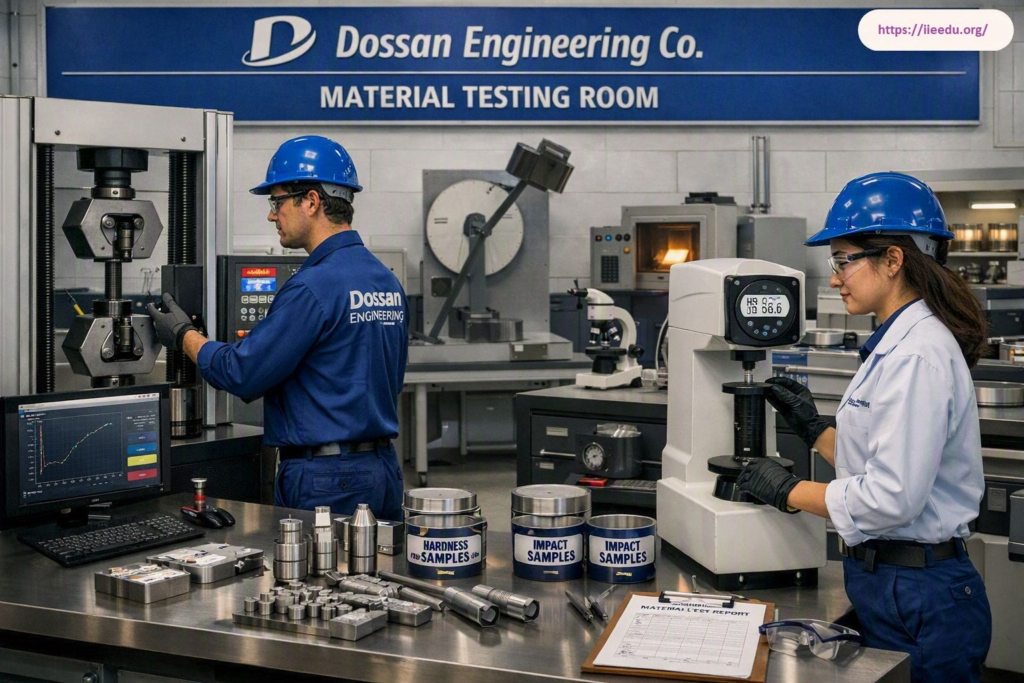
The achievement of ISO 9001 certification in 2018 gave Dossan Engineering Co. something more valuable than a certificate—it gave the organization confidence. For years, the company had believed that disciplined work and customer satisfaction were essential. Now those beliefs had been transformed into a structured quality management system.
The promoter understood, however, that certification itself would not guarantee growth. The real test would begin after the certificate was received. Customers would judge the company not by what was written in its quality manual, but by what they experienced through every order, communication, inspection, and delivery.
The first few months after certification therefore became a period of careful observation.
The promoter began reviewing customer feedback more seriously. Every complaint, delay, rejection, and unexpected difficulty was discussed with the team. Instead of asking who was responsible for a problem, the company increasingly asked a more important question: Why did the system allow the problem to happen?
This small change in thinking had a powerful effect.
When an issue occurred, employees were encouraged to identify its root cause. Corrective actions were documented, implemented, and reviewed. Over time, recurring problems began to reduce. The organization was learning to prevent mistakes rather than simply react to them.
Customer communication also improved.
Earlier, much of the company’s communication had depended on individual employees remembering details. After certification, requirements were recorded more systematically. Quotations, specifications, purchase requirements, inspection information, and delivery commitments became easier to track.
This created greater transparency between Dossan Engineering Co. and its customers.
A customer calling about an order could receive a more precise response. Internal employees could understand the status of an order without relying entirely on verbal explanations. The promoter could review business activities with greater clarity.
The effect was visible in customer relationships.
Some existing customers began placing repeat orders with greater confidence. New inquiries also increased as Dossan Engineering Co. developed a reputation for professionalism. The company was no longer perceived simply as a small engineering supplier. It was gradually becoming a dependable business partner.
For the promoter, this was particularly meaningful.
He remembered the early days when winning a single customer required numerous visits and persistent follow-up. Now customers were beginning to recognize the company because of its capabilities and reputation.
But growth brought new challenges.
More orders meant greater pressure on resources. Suppliers had to be monitored more carefully. Inventory planning became increasingly important. Employees needed to manage several priorities simultaneously. Delivery schedules became more demanding.
The promoter knew that uncontrolled growth could be as dangerous as stagnation.
He therefore emphasized planning.
Production and procurement activities were reviewed more carefully. Supplier performance was evaluated. Material requirements were anticipated rather than handled only when an order arrived. Employees were encouraged to communicate potential delays early.
This culture of communication helped the company avoid many problems.
Another important development was employee confidence. Before the quality-management journey, some employees had viewed their responsibilities as individual tasks. After certification, they began to understand how their work connected to the wider business process.
The person responsible for purchasing affected material quality.
The person handling inspection affected customer satisfaction.
The person maintaining records affected traceability.
The person coordinating dispatch affected delivery performance.
Everyone became part of the quality chain.
The promoter frequently reminded his team that an organization becomes strong when every employee understands the importance of his or her contribution.
This philosophy also influenced recruitment. As the company expanded, Dossan Engineering Co. began looking for people who possessed not only technical skills but also discipline, responsibility, and a willingness to learn.
The company’s office environment gradually changed. What had once been a small operation dependent on the founder’s constant intervention was developing into a more organized enterprise.
The promoter himself had to change.
For years, he had personally controlled almost every important decision. But growth required delegation. He began assigning responsibilities to trusted employees and encouraging them to make decisions within defined limits.
At first, delegation was difficult.
A founder who has built a company through personal effort naturally worries that others may not handle responsibilities exactly as he would. But the promoter recognized that if every decision continued to depend on him, the company would never reach its full potential.
He therefore adopted a new principle:
Build people, and people will build the company.
Training, communication, and accountability became increasingly important. Employees were given opportunities to understand not only what they had to do, but also why their work mattered.
The benefits appeared gradually.
Meetings became more purposeful. Problems were discussed earlier. Decisions became faster. Employees developed greater ownership. The promoter gained more time to focus on customers, strategy, and future opportunities.
By the end of this phase, Dossan Engineering Co. had changed in ways that were not immediately visible from outside.
The office was still located at 205, Bagsons Industrial Estate, 2nd Floor, 40, Chakala Road, Andheri East, Mumbai – 400099. The company’s name was still the same. Its fundamental business remained rooted in engineering.
Yet internally, the organization was different.
ISO 9001 had introduced discipline.
Discipline had created consistency.
Consistency had created confidence.
And confidence was beginning to create growth.
The promoter now started thinking beyond survival and operational stability. He began asking larger questions.
Could Dossan Engineering Co. enter new markets?
Could the company develop stronger sustainability practices?
Could it build products that responded to the changing environmental expectations of industry?
Could it create a future in which business growth and responsible manufacturing supported each other?
One particular opportunity began to attract his attention: the growing importance of sustainable industrial practices.
Across the manufacturing sector, customers were becoming increasingly conscious of energy efficiency, resource conservation, waste reduction, and environmental responsibility. Sustainability was no longer simply a corporate slogan. It was becoming part of competitiveness.
For Dossan Engineering Co., this represented a new possibility.
The company had already established a foundation through ISO 9001. Now it could begin building another dimension of its identity—one based on sustainable performance.
The promoter realized that the next chapter of growth would not be about producing more alone.
It would be about producing better, smarter, and more responsibly.
That vision would eventually lead Dossan Engineering Co. toward its association with GreenCo Bronze, opening another important chapter in its journey from a small engineering enterprise to a more mature and forward-looking organization.
#ISO9001
Chapter 4 – The Green Transformation

The years following ISO 9001 certification brought a new realization to the promoter of Dossan Engineering Co. Quality had strengthened the company from within, but the industrial world around it was changing rapidly. Customers were becoming more conscious of sustainability, resource efficiency, energy consumption, waste reduction, and responsible manufacturing.
The promoter understood that remaining competitive would require more than maintaining product quality. Dossan Engineering Co. needed to prepare itself for the future.
The idea of sustainability initially seemed like a large subject for a growing engineering company. Environmental performance involved many areas—energy, water, materials, waste, employee awareness, transportation, and operational practices. Yet the promoter believed that meaningful change did not always require dramatic investment. Sometimes it began with small improvements repeated consistently.
He called a meeting with his team and explained his vision.
“Quality tells us how well we perform,” he said. “Sustainability asks us how responsibly we perform. We must learn to do both.”
This philosophy became the starting point of Dossan Engineering Co.’s next transformation.
The company began examining its daily operations. Employees looked at electricity consumption, lighting, equipment usage, paper consumption, material handling, waste generation, and housekeeping. Areas of unnecessary consumption were identified.
Simple measures were introduced first.
Lights and electrical equipment were switched off when not required. Employees were encouraged to avoid unnecessary printing. Documents were increasingly shared electronically. Waste materials were segregated wherever practical. Housekeeping standards were strengthened.
None of these measures appeared revolutionary on their own. But together they began creating a new mindset.
The promoter emphasized that sustainability should not become a separate department or a temporary campaign. It had to become part of the company culture.
Employees were encouraged to think before consuming resources.
Could a process use less material?
Could a delivery be planned more efficiently?
Could waste be reduced?
Could a document be handled electronically?
Could equipment be operated more efficiently?
These questions gradually became part of everyday conversations.
The company also began paying closer attention to its suppliers. Quality remained important, but the promoter increasingly considered reliability, responsible practices, and consistency when evaluating business partners. The objective was to create a supply chain that supported the company’s broader goals.
At the same time, Dossan Engineering Co. continued to focus on customer requirements. The promoter knew that sustainability could not come at the expense of quality or delivery. Instead, the three objectives had to support one another.
Quality, productivity, and sustainability were therefore treated as connected.
A reduction in material waste could improve both environmental performance and cost efficiency.
Better planning could reduce unnecessary movement and delays.
Improved maintenance could increase equipment efficiency while reducing breakdowns.
Digital documentation could reduce paper consumption while improving accessibility.
The company began to recognize that sustainable practices were not merely expenses. They could also create operational benefits.
This thinking eventually led Dossan Engineering Co. toward the GreenCo framework.
The promoter was attracted to the idea because it provided a structured way to assess sustainability rather than relying on vague claims. The company could examine its performance, identify opportunities for improvement, and establish measurable objectives.
The journey toward GreenCo Bronze required another period of learning.
Employees who had become familiar with ISO 9001 now had to understand a different set of expectations. Workshops and internal discussions focused on environmental responsibility, resource conservation, energy efficiency, waste management, and continuous improvement.
Some employees initially believed sustainability was mainly about environmental protection. Gradually, they learned that a broader approach was involved.
Sustainable business performance also meant using resources intelligently, reducing unnecessary losses, improving productivity, and building resilience for the future.
The promoter repeatedly connected sustainability with the company’s long-term survival.
“A business should not only ask what it can earn today,” he explained. “It must also ask what kind of organization it wants to become tomorrow.”
This message resonated with the younger members of the team.
They began suggesting practical ideas. Some proposed reducing paper use. Others identified unnecessary energy consumption. Employees discussed better housekeeping and waste segregation. Suggestions that might previously have been ignored were now recorded and reviewed.
The company began to develop a culture where improvement could come from anyone.
This was one of the most important lessons from the ISO journey: a management system becomes powerful when employees participate in it.
As preparations continued, the promoter realized that the company had reached an important stage of maturity. ISO 9001 had taught Dossan Engineering Co. to control quality systematically. The sustainability journey was teaching it to think about the wider consequences of its operations.
The achievement of GreenCo Bronze became an important milestone.
For the company, the recognition represented more than a title. It demonstrated that the organization was taking measurable steps toward sustainable industrial practices. It also provided a new dimension to its identity in the eyes of customers, employees, suppliers, and other stakeholders.
The promoter felt a quiet sense of satisfaction when he looked back at the company’s journey.
There had been a time when Dossan Engineering Co. was simply trying to secure its next order.
Then came the effort to build credibility.
Then ISO 9001.
Then process discipline.
Now came sustainability.
Each stage had built upon the previous one.
The company had learned that growth was not simply measured by turnover or the number of customers. Growth could also be measured by the maturity of systems, the confidence of employees, the trust of customers, the efficiency of operations, and the responsibility shown toward resources.
The GreenCo Bronze journey therefore became another chapter in Dossan Engineering Co.’s evolution.
The company had started with a promoter’s dream.
It had survived through determination.
It had strengthened itself through quality.
And now it was beginning to grow through responsibility.
As the calendar moved toward 2021, the promoter knew that the journey was far from complete. The ISO 9001 certification period from 2018 to 2021 had given the organization a valuable foundation, while the GreenCo initiative had opened a new direction.
The next challenge would be to ensure that these achievements became permanent—not temporary milestones, but lasting habits embedded in the company’s future.
Dossan Engineering Co. had learned how to build a quality organization.
Now it had to prove that it could build a sustainable one.
#QualityManagement
Chapter 5 – People Behind the Progress
Courtesy: Doosan
Every successful company has a story that cannot be told through certificates, machines, buildings, or financial figures alone. Behind every achievement are people who arrive each morning, solve problems, serve customers, maintain processes, and continue working when circumstances become difficult. For Dossan Engineering Co., the years after ISO 9001 certification revealed an important truth: the company’s greatest strength was its people.
The promoter had always believed that employees should not be treated merely as workers. They were partners in the company’s journey. This belief became even more important as the organization adopted more structured quality and sustainability practices.
In the early years, the small team had worked almost entirely through personal communication. Everyone knew everyone else’s responsibilities. If a customer called, somebody could usually find the required information. If a problem occurred, the promoter personally became involved.
Growth changed this.
As orders increased and systems became more sophisticated, informal communication was no longer enough. Employees needed defined responsibilities, proper training, and confidence in their own decisions.
The promoter therefore began encouraging a culture of learning.
Training was not restricted to technical subjects. Employees were introduced to quality procedures, documentation, workplace discipline, customer communication, safety awareness, resource conservation, and the importance of continuous improvement.
At first, some employees were uncomfortable with the additional structure. They were accustomed to doing their work through experience. Now they had to record activities, follow procedures, and demonstrate that processes were being controlled.
The promoter understood their concerns.
He did not want employees to feel that systems existed to monitor them. He wanted them to understand that systems existed to protect the company and its customers.
During one internal discussion, an employee asked why so many records were necessary for activities that the team already knew how to perform.
The promoter smiled and answered, “Experience is valuable, but a good organization must make its knowledge stronger than any single individual. If one person is absent tomorrow, the system should still work.”
That statement became an important principle within Dossan Engineering Co.
Knowledge began to be shared rather than retained by individuals.
Employees documented important information. Procedures became clearer. Responsibilities were communicated more effectively. New employees could learn from established systems rather than depending entirely on informal instructions.
The transformation also encouraged employees to speak more openly.
If a supplier was creating repeated problems, the purchasing team could raise the issue.
If a process created unnecessary waste, employees could suggest improvement.
If a customer requirement appeared unclear, the team could seek clarification before proceeding.
The promoter welcomed such communication because he believed that silence was more dangerous than disagreement.
Over time, employees began taking ownership.
One of the most noticeable changes was the willingness of team members to suggest small improvements. Someone might identify unnecessary paperwork. Another might recommend a better method of organizing records. Someone else might notice that energy was being consumed unnecessarily.
Individually, these suggestions appeared minor. Collectively, they created momentum.
This was particularly important during the company’s sustainability journey. GreenCo-related initiatives required participation from everyone. A sustainability policy could be written by management, but it could not succeed unless employees followed it.
The company therefore encouraged simple habits.
Switching off unused equipment.
Reducing unnecessary printing.
Maintaining good housekeeping.
Segregating waste.
Using resources carefully.
Planning activities efficiently.
Avoiding unnecessary rework.
These habits gradually became part of the workplace culture.
The promoter also understood that employee motivation could not depend entirely on financial rewards. Recognition mattered.
When an employee solved a difficult problem or suggested a useful improvement, the effort was acknowledged. Team achievements were discussed during meetings. Employees were encouraged to understand how their contributions helped customers and strengthened the organization.
This created a sense of pride.
People were no longer simply completing tasks. They were participating in the growth of Dossan Engineering Co.
The company also learned an important lesson about leadership.
The promoter had once believed that being a strong leader meant having all the answers. With experience, he discovered that leadership was often about asking the right questions and allowing others to find solutions.
Instead of immediately solving every problem, he began asking employees:
“What do you think caused this?”
“What can we change?”
“How can we prevent it from happening again?”
“What support do you need?”
These questions encouraged independent thinking.
Managers and senior employees gradually became more comfortable taking responsibility. The organization became less dependent on the promoter for routine decisions, allowing him to concentrate more on strategy, customer relationships, business development, and future opportunities.
The result was a healthier organization.
There was greater accountability without creating fear.
There was discipline without eliminating flexibility.
There was structure without destroying the entrepreneurial spirit that had built the company.
By 2021, Dossan Engineering Co. had travelled a considerable distance from its early days. The office remained a working industrial environment, but the thinking inside it had changed.
The company had developed a stronger understanding of quality.
It had embraced sustainability.
It had created more systematic processes.
And, most importantly, it had developed employees who understood that their daily decisions influenced the company’s reputation.
For the promoter, this was perhaps the most satisfying achievement of all.
A certificate could demonstrate compliance.
A GreenCo recognition could demonstrate commitment to sustainability.
But people demonstrated the company’s character every day.
He often looked around the office during the busiest hours and remembered the early days when almost everything depended on his personal effort. Now the company moved because many people were contributing their knowledge and energy.
That was real growth.
Dossan Engineering Co. had begun as a promoter’s dream, but it was no longer only his dream.
It had become a shared vision.
And as the company prepared for the next stage of its journey, that shared vision would become its strongest foundation.
#GreenCoBronze
Chapter 6 – Building Customer Trust
Dossan Engineering Co., growth was never simply a matter of increasing the number of orders. The promoter understood that sustainable business growth depended on something much more valuable: customer trust.
A customer might place one order because of price, availability, or convenience. But repeat business came from confidence. Customers needed to believe that Dossan Engineering Co. would understand their requirements, maintain quality, communicate honestly, and deliver consistently.
This philosophy became increasingly important after the company’s ISO 9001 certification in 2018.
The certification strengthened the company’s internal systems, but its real value was visible in the way customers experienced the organization. Processes became more structured, records were easier to trace, and responsibilities were clearer. The company could respond to customer requirements with greater confidence.
The promoter often reminded his team that every customer interaction represented the company.
A telephone call mattered.
An email mattered.
A quotation mattered.
A delivery mattered.
Even a small commitment mattered.
If a customer was promised a particular date, the company had to treat that commitment seriously. If a specification was unclear, clarification had to be obtained rather than assumed. If a problem occurred, communication had to be immediate.
This approach helped Dossan Engineering Co. develop stronger relationships with customers.
In the early years, the promoter had personally managed many customer relationships. As the company grew, he began training employees to maintain the same level of attention.
He told them, “A customer should feel that we are solving their problem, not merely selling them something.”
That philosophy changed the way the team approached business.
Instead of focusing only on the immediate order, employees tried to understand the customer’s broader requirement. What application was involved? What delivery schedule was necessary? What quality expectations existed? What documentation would be required?
This additional attention created value.
Customers appreciated suppliers who asked the right questions before problems occurred.
The company also learned from difficult situations.
There were occasions when deliveries were delayed because of circumstances beyond the company’s direct control. There were times when material availability created pressure. In such situations, the easiest option would have been to remain silent and hope that the problem disappeared.
The company chose a different approach.
Customers were informed.
Alternative solutions were discussed.
Expectations were managed honestly.
The promoter believed that bad news communicated early was better than good news promised falsely.
This principle strengthened credibility.
Over time, customer relationships became less transactional and more collaborative. Customers began approaching Dossan Engineering Co. not only for products but also for discussions about requirements, specifications, availability, and possible solutions.
The company was becoming a partner rather than simply a supplier.
Quality management played an important role in this development. ISO 9001 encouraged the organization to monitor customer satisfaction and learn from feedback. Complaints were no longer viewed merely as negative events. They became sources of information.
Whenever a complaint was received, the team investigated the circumstances.
Was the requirement misunderstood?
Was there a supplier issue?
Was inspection insufficient?
Was communication incomplete?
Was there a process weakness?
The objective was not to assign blame but to prevent recurrence.
This approach created a continuous learning cycle.
Customer feedback led to internal improvement.
Internal improvement led to better performance.
Better performance created stronger customer confidence.
Stronger confidence created repeat business.
And repeat business supported growth.
The promoter recognized another important aspect of customer trust: consistency.
A company that performs well once is encouraging. A company that performs well repeatedly becomes dependable.
Therefore, Dossan Engineering Co. focused on maintaining standards even when orders were urgent or workloads were high.
Employees were encouraged not to compromise essential quality checks simply because a customer required faster delivery. At the same time, the team learned to improve planning so that urgency could be handled without unnecessary disruption.
This balance between responsiveness and discipline became a defining characteristic of the organization.
The company’s sustainability efforts also began contributing to its reputation. As industries became more conscious of environmental responsibility, Dossan Engineering Co.’s GreenCo Bronze journey demonstrated that the company was thinking beyond immediate commercial objectives.
For customers, this was increasingly meaningful.
Businesses were beginning to evaluate suppliers on broader criteria. Quality remained essential, but responsible practices, resource efficiency, and organizational maturity were becoming important considerations.
Dossan Engineering Co. could now demonstrate progress in both areas.
The promoter was proud of this development, but he remained cautious about making exaggerated claims. He believed that reputation should be earned through action.
“A company should not tell customers that it is reliable,” he would say. “It should give customers enough experience that they say it themselves.”
That principle guided the company as it continued developing.
By 2021, customer relationships had become one of Dossan Engineering Co.’s most valuable assets. The company had learned that trust was accumulated slowly but could be lost quickly. Every employee therefore had a role in protecting it.
A delayed response could weaken confidence.
An unchecked error could damage credibility.
An honest explanation could strengthen a relationship.
A successful delivery could create another opportunity.
The promoter understood that business growth was ultimately built through thousands of such moments.
The company’s journey from its modest beginnings to ISO 9001 certification and GreenCo Bronze recognition had therefore created something that could not be measured by certificates alone.
It had created credibility.
Customers increasingly saw Dossan Engineering Co. as an organization that was serious about quality, committed to improvement, and willing to evolve with changing industrial expectations.
That reputation opened new possibilities.
With stronger customer relationships, better internal systems, and a growing commitment to sustainability, Dossan Engineering Co. was ready to look beyond its existing boundaries.
The next stage would require the company to explore new markets, strengthen its capabilities, and think more strategically about expansion.
The promoter knew that the road ahead would not be easy.
But for the first time, he felt that the company possessed the foundation required to travel it.
The business was no longer built only on hope.
It was built on quality, people, systems, sustainability, and trust.
And those foundations would shape the next chapter of its growth.
#SustainableEngineering
Chapter 7 – Expanding the Horizon
The company had moved from an informal, promoter-driven operation toward a more structured organization supported by quality systems, trained employees, customer confidence, and a growing awareness of sustainability.
The promoter now faced a new question.
How could the company convert this foundation into sustainable business growth?
The answer would require courage.
Growth meant accepting larger responsibilities. It meant entering new customer segments, responding to more demanding requirements, strengthening supplier relationships, and investing in people. It also meant accepting that the methods that worked when the company was small might not be sufficient for the next stage.
The promoter began looking at the market differently.
Earlier, he had focused primarily on obtaining orders and completing them successfully. Now he studied broader industry trends. He considered what customers would require in the coming years, what competitors were doing, and how technology and sustainability were changing purchasing decisions.
He realized that customers were becoming more sophisticated.
They expected reliable quality, faster communication, accurate documentation, competitive pricing, and responsible business practices. A supplier could no longer depend on one strength alone.
Dossan Engineering Co. therefore continued strengthening its processes.
The ISO 9001 framework provided discipline, while the company’s GreenCo Bronze journey encouraged greater attention to sustainability. Together, these systems helped the company develop a more balanced approach to growth.
The promoter also recognized that expansion could create pressure on quality.
If the company accepted more orders without improving capacity and coordination, delivery performance could suffer. If it grew too quickly, employees could become overloaded. If supplier relationships were not managed carefully, material quality could become inconsistent.
Growth, therefore, had to be controlled.
Planning became increasingly important.
Customer forecasts and order requirements were reviewed. Procurement activities were coordinated more carefully. Supplier performance was monitored. Internal responsibilities were clarified.
The company began thinking several steps ahead.
Instead of asking, “How do we complete this order?” employees increasingly asked, “What will we need to complete this order successfully?”
This change reduced last-minute pressure and improved preparedness.
At the same time, the promoter continued developing the organization’s people. New responsibilities required new skills. Employees were encouraged to improve technical knowledge, communication abilities, documentation practices, and problem-solving skills.
The company also began recognizing the importance of technology.
Digital records made information easier to access. Electronic communication improved response times. Data could be used to understand trends and identify recurring problems. The promoter did not want technology simply because it appeared modern; he wanted technology that created practical value.
His philosophy was simple: adopt a tool when it improves quality, efficiency, communication, or customer service.
This approach helped the company avoid unnecessary complexity.
The promoter also understood that expansion depended on reputation.
The company could approach new customers with greater confidence because it could demonstrate its commitment to quality management and sustainability. ISO 9001 certification provided evidence of a structured quality approach, while GreenCo Bronze represented progress toward sustainable industrial practices.
These achievements strengthened the company’s professional identity.
During customer meetings, the promoter could speak not only about products and prices but also about systems, quality, continuous improvement, and sustainability.
This changed the nature of business discussions.
Customers increasingly wanted long-term relationships rather than temporary suppliers. Dossan Engineering Co. was well positioned to respond.
Still, every opportunity brought a decision.
Should the company accept an order if the margin was low?
Should it work with a new supplier offering a cheaper price?
Should it expand into a new market before the necessary capabilities were fully established?
The promoter learned to evaluate opportunities carefully.
He believed that not every order was a good order and not every form of growth was healthy growth.
The company needed customers who valued quality and reliability.
It needed suppliers who could support consistent performance.
It needed employees who could grow with increasing responsibilities.
And it needed business decisions that protected the company’s long-term reputation.
This discipline helped Dossan Engineering Co. avoid the temptation of uncontrolled expansion.
Instead, growth became gradual and purposeful.
Every successful project increased confidence. Every new customer created another opportunity to demonstrate capability. Every operational improvement strengthened the organization.
The promoter also began thinking about the company’s identity beyond its immediate commercial activities.
He wanted Dossan Engineering Co. to be recognized as a company that could adapt.
The engineering industry would continue changing. Customer expectations would evolve. Sustainability requirements would become stronger. Technology would continue transforming business processes.
A company that stopped learning would eventually fall behind.
Therefore, continuous improvement became a permanent principle.
The promoter encouraged employees to remain curious.
If a process could be improved, discuss it.
If a customer had a better suggestion, listen.
If a mistake occurred, learn from it.
If technology offered a useful solution, investigate it.
If sustainability could be improved, act.
This attitude created resilience.
By the time the company approached the end of its 2018–2021 ISO 9001 certification period, Dossan Engineering Co. was no longer the same organization that had first considered certification.
The transformation was visible in its systems and processes, but it was even more visible in its mindset.
The company had learned to think beyond individual orders.
It was thinking about long-term relationships.
It was thinking about sustainable growth.
It was thinking about people.
It was thinking about reputation.
And it was thinking about the future.
The promoter stood one evening near the window of the company’s office and looked at the busy roads of Andheri East. Mumbai continued moving around him—vehicles, factories, offices, workers, customers, and businesses all competing to create their own future.
Dossan Engineering Co. was part of that enormous industrial ecosystem.
Its beginnings had been modest.
Its challenges had been real.
Its progress had been gradual.
But the company had learned one important lesson: a business does not become successful simply by becoming larger. It becomes successful by becoming stronger.
Stronger systems.
Stronger people.
Stronger customer relationships.
Stronger values.
Stronger responsibility.
As the company looked toward the future, the promoter knew that the next chapter would bring new challenges. Markets would change, technology would advance, and customer expectations would continue rising.
But he was no longer afraid of change.
Dossan Engineering Co. had learned how to change without losing its identity.
And that ability would become one of its greatest competitive strengths.
#ContinuousImprovement
Chapter 8 – The Test of Resilience
Every growing company eventually encounters a period when its plans are tested by circumstances beyond its control. For Dossan Engineering Co., the years around 2020 became such a period. The business environment changed rapidly, customer priorities shifted, supply chains experienced uncertainty, and organizations across industries were forced to reconsider how they operated.
For a company that had spent years building systems and relationships, this was the moment when those preparations would be tested.
The promoter understood immediately that the priority had to be people.
The health and safety of employees came first. At the same time, the company had responsibilities toward customers, suppliers, and business partners. Orders had to be reviewed carefully, commitments had to be reassessed, and communication had to become more frequent.
The old way of managing business—depending on physical presence and informal communication—was no longer sufficient.
Fortunately, the transformation that had begun with ISO 9001 had already introduced greater structure into Dossan Engineering Co.
Records were organized.
Responsibilities were defined.
Customer requirements were documented.
Supplier information could be reviewed.
Processes were more clearly understood.
These systems gave the company an important advantage during uncertainty.
The promoter called his team together and explained that nobody could predict exactly what would happen next. But they could control how they responded.
“We cannot control the situation outside,” he told them, “but we can control our discipline, our communication, and the way we treat our customers and each other.”
This became the guiding principle for the difficult period ahead.
Customer communication was strengthened. Instead of waiting for problems to become urgent, employees contacted customers proactively. Delivery schedules were discussed honestly. Requirements were reviewed carefully. Where circumstances created difficulties, alternative arrangements were explored.
This honesty helped preserve trust.
Some customers were facing their own challenges. Their production plans changed. Their requirements became uncertain. In such circumstances, Dossan Engineering Co. avoided unnecessary pressure and tried to understand the customer’s situation.
The promoter believed that relationships built during difficult times could become stronger than relationships built during easy times.
Suppliers were also affected by uncertainty. Material availability and delivery schedules became more difficult to predict. The company therefore began reviewing procurement plans more carefully.
Where possible, alternative sources were considered. Existing suppliers were contacted regularly. Material requirements were planned earlier.
This experience reinforced an important lesson: a company’s resilience depends partly on the resilience of its supply chain.
Internally, employees had to adapt to new methods of working.
Meetings became more focused.
Communication increasingly depended on digital channels.
Documents were shared electronically wherever practical.
Routine activities were reviewed to determine what could be handled remotely and what required physical presence.
The promoter had once believed that technology was mainly a tool for efficiency. Now he recognized that technology could also provide continuity during disruption.
The company’s digital capabilities improved as employees became more comfortable with electronic communication and documentation.
Yet technology alone was not enough.
The most important factor remained trust.
Employees needed to trust management.
Management needed to trust employees.
Customers needed to trust the company.
Suppliers needed to trust that commitments would be honored.
The promoter therefore placed great emphasis on communication.
Even when there was no major update, employees were kept informed. Questions were answered as openly as possible. Concerns were acknowledged rather than ignored.
This created stability during an unstable period.
Financial discipline also became important. The promoter reviewed expenses carefully and prioritized activities that were essential to business continuity. The objective was not to stop investment completely but to ensure that resources were used intelligently.
The company had learned through its sustainability journey that efficiency was not merely an environmental concept. It was also a business necessity.
Reducing waste, avoiding unnecessary expenditure, planning resources carefully, and improving productivity all helped strengthen resilience.
The GreenCo Bronze philosophy therefore became relevant in an unexpected way.
Sustainability was not only about environmental performance. It encouraged the company to think about long-term resource management and responsible decision-making.
The difficult period also brought employees closer together.
People began helping one another in ways that went beyond their formal responsibilities. If one employee faced difficulty accessing information, another helped. If a customer needed urgent clarification, team members coordinated quickly.
The promoter saw this as evidence that the company culture had matured.
The organization was no longer held together only by procedures.
It was held together by people who cared about its future.
Gradually, business conditions began stabilizing. Customers resumed plans. Requirements became clearer. Supply chains improved. Employees adapted to new working practices.
Dossan Engineering Co. emerged from the difficult period with valuable lessons.
The company learned that planning was important, but flexibility was equally important.
It learned that systems mattered, but people mattered more.
It learned that customer relationships needed to be protected even when business was uncertain.
It learned that digital communication could improve resilience.
And it learned that sustainability and operational efficiency could strengthen the business during challenging circumstances.
Most importantly, the promoter realized that the company had developed something that could not have been purchased or installed: resilience.
The years leading up to this period had prepared Dossan Engineering Co. in ways the company could not fully appreciate at the time.
ISO 9001 had taught it discipline.
GreenCo had encouraged responsible resource management.
Employee development had created flexibility.
Customer-focused practices had created trust.
Together, these foundations helped the company face uncertainty with greater confidence.
As the promoter looked toward the future, he understood that resilience would remain essential. The next challenge might come from market competition, technology, changing regulations, customer expectations, or economic conditions.
No company could predict every challenge.
But a company could prepare itself to respond.
Dossan Engineering Co. had learned how.
The difficult years had not stopped the company’s journey.
Instead, they had strengthened its character.
And when the market began opening new opportunities again, the company was ready to move forward—not with the confidence of an organization that believed it would never face difficulties, but with the confidence of one that had learned how to overcome them.
#CustomerTrust
Chapter 9 – The GreenCo Bronze Milestone
Courtesy: Shanghai Zirui Machinery Trading Co., Ltd.
The journey toward GreenCo Bronze represented a new chapter in the development of Dossan Engineering Co. While ISO 9001 had strengthened the company’s approach to quality management, the GreenCo journey encouraged the organization to look at business performance from a wider perspective.
The promoter had come to understand that a modern engineering company could not measure success only through orders, revenue, and production. Responsible use of resources, environmental awareness, operational efficiency, and employee participation were becoming increasingly important.
For Dossan Engineering Co., GreenCo Bronze was therefore not simply another recognition. It represented a change in the way the company viewed its responsibilities.
The journey began with awareness.
Employees were encouraged to understand how everyday business activities affected the environment and the company’s resources. Electricity, water, paper, materials, transportation, and waste were no longer considered isolated operational details. Each represented an opportunity for improvement.
The promoter emphasized that sustainability did not always require expensive technology.
Sometimes, the most effective improvements came from changing habits.
An unnecessary light could be switched off.
A document could be shared electronically.
Waste could be separated properly.
A process could be planned to avoid rework.
Materials could be handled more carefully.
Equipment could be maintained to operate efficiently.
These actions appeared simple, but the company recognized that sustainability was created through thousands of such decisions.
The next step was to understand where improvement was possible.
The team began examining existing practices. Employees discussed resource consumption, waste generation, housekeeping, operational efficiency, and opportunities to reduce unnecessary usage.
This exercise created an important realization: many sustainability improvements could also improve productivity.
For example, reducing material waste could lower costs. Better planning could reduce unnecessary movement. Preventive maintenance could improve equipment performance. Digital records could reduce paper consumption while making information easier to access.
Sustainability and efficiency were therefore not competing objectives.
They could reinforce one another.
This understanding changed the attitude of employees.
Instead of seeing sustainability as an additional responsibility imposed by management, employees began seeing it as part of good business practice.
The promoter encouraged suggestions from every level of the organization.
A junior employee might notice unnecessary printing.
A senior employee might identify an inefficient process.
A purchasing team member might suggest a more reliable supplier.
An administrative employee might recommend a digital alternative to a paper-based process.
Every idea was considered.
Some ideas were implemented immediately. Others required additional evaluation. The important point was that employees knew their suggestions were being heard.
This participation strengthened the culture of continuous improvement that had already developed through ISO 9001.
The company also began emphasizing awareness among visitors, suppliers, and other stakeholders wherever practical. Sustainability could not remain confined to one department. It had to become part of the broader organizational environment.
The promoter often explained that the company’s future depended on responsible growth.
“Growth without discipline creates problems,” he said. “Growth with responsibility creates strength.”
This principle became particularly relevant as Dossan Engineering Co. continued expanding its customer relationships.
Customers were increasingly interested in the capabilities and practices of their suppliers. Quality certifications demonstrated process discipline. Sustainability initiatives demonstrated awareness of broader responsibilities.
The combination gave Dossan Engineering Co. a stronger professional identity.
The achievement of GreenCo Bronze therefore became an important milestone.
When the recognition was received, the promoter did not treat it as the end of the journey. Instead, he gathered the team and thanked them for their participation.
“This belongs to everyone,” he said. “The recognition may carry the company’s name, but the effort belongs to the people who changed their daily habits.”
The employees understood the significance.
They remembered the days when quality documentation had seemed unfamiliar. They remembered the introduction of new procedures and the effort required to establish discipline. Now they were experiencing another transformation.
The company had moved from simply talking about improvement to creating systems for it.
GreenCo Bronze also encouraged the promoter to think about the future.
If the company could improve its sustainability practices once, it could improve them again.
The objective was not to stop at Bronze. The company could continue measuring performance, identifying opportunities, and developing stronger practices over time.
This became part of the company’s long-term vision.
The promoter also recognized that sustainability could support employee pride.
People increasingly wanted to work for organizations that demonstrated responsibility. Employees could see that their workplace was not concerned only with commercial success. It was also trying to operate more efficiently and responsibly.
This strengthened the connection between people and the organization.
The GreenCo journey also reinforced the promoter’s belief that certifications and recognitions should lead to real improvement.
A certificate had value only when the practices behind it were genuine.
A recognition had meaning only when employees continued those practices after the assessment was complete.
Therefore, Dossan Engineering Co. focused on maintaining the improvements rather than treating GreenCo Bronze as a one-time achievement.
By 2021, the company could look back on several years of transformation.
In 2018, ISO 9001 certification had established a stronger quality foundation.
The years that followed had brought greater process discipline, customer confidence, employee development, and sustainability awareness.
GreenCo Bronze became another visible symbol of this transformation.
For the promoter, the journey was deeply personal.
He remembered the early days when the company’s primary objective had been survival.
Now the organization was discussing quality, sustainability, efficiency, employee development, and long-term strategy.
The physical office had changed little compared with the transformation inside it.
The biggest change was in the mindset.
Dossan Engineering Co. had learned to ask better questions.
Not only, “Can we do this?”
But also:
“Can we do it better?”
“Can we do it more efficiently?”
“Can we reduce waste?”
“Can we create greater value for the customer?”
“Can we build a stronger future?”
Those questions became part of the company’s identity.
GreenCo Bronze was therefore not the conclusion of Dossan Engineering Co.’s journey.
It was a milestone on a much longer road.
The company had begun with a dream of building a successful engineering enterprise.
Through quality, discipline, people, customer trust, resilience, and sustainability, that dream had become a living organization.
And the promoter knew that the most important part of the journey was still ahead.
#OperationalExcellence
Chapter 10 – The Road Ahead
As Dossan Engineering Co. entered the later stages of its 2018–2021 journey, the promoter began to understand that the company’s greatest achievement was not a single certification, customer, or business milestone. It was the transformation of the organization itself.
The company had started with limited resources and a simple objective: serve customers honestly and build a sustainable engineering business. Over time, that objective had evolved into something much larger.
ISO 9001 had introduced discipline.
Customer relationships had created confidence.
Employee development had created capability.
GreenCo Bronze had introduced a stronger sustainability perspective.
Together, these elements had changed the way Dossan Engineering Co. viewed growth.
The promoter now looked toward the future with a mixture of satisfaction and responsibility. He knew that success could never be treated as permanent. Markets would change. Competitors would improve. Customers would demand more. Technology would create new opportunities while also making older methods less effective.
The company therefore needed to remain willing to learn.
One of the promoter’s priorities was to ensure that the quality culture developed after ISO 9001 certification remained strong. He did not want employees to think of quality as something that belonged only to an audit or certification period.
Quality had to remain part of everyday work.
Customer requirements needed to be understood correctly.
Processes needed to be followed consistently.
Problems needed to be investigated.
Corrective actions needed to be completed.
Records needed to remain reliable.
Most importantly, employees needed to continue asking how processes could be improved.
The promoter also wanted sustainability to remain an active part of the company’s thinking.
GreenCo Bronze had demonstrated that Dossan Engineering Co. could take measurable steps toward responsible operations. The next challenge was to continue that progress.
The company could look for additional opportunities to reduce resource consumption, improve efficiency, strengthen waste management, and encourage employee participation.
The promoter believed that sustainability should never become a slogan.
“If we say we care about sustainability,” he told his team, “then our daily decisions must show it.”
This principle extended to customers and suppliers.
The company wanted to build relationships with organizations that valued quality, reliability, and responsible business practices. Long-term partnerships were considered more valuable than short-term transactions.
The promoter also understood that the next stage of growth would require stronger leadership from the second line of the organization.
For years, his personal involvement had been essential. But a mature company could not depend forever on one individual.
He therefore continued encouraging employees to take ownership.
People were given responsibilities and expected to make decisions within their areas of authority. Managers were encouraged to develop their own teams. Younger employees were given opportunities to learn from experienced colleagues.
The objective was to create continuity.
The promoter wanted Dossan Engineering Co. to remain strong even when circumstances changed or individual people moved on.
This was one of the most important lessons he had learned from the company’s growth: a successful promoter does not simply build a business; he builds an organization capable of continuing beyond him.
Technology also became an important part of the future vision.
The promoter knew that engineering businesses would increasingly depend on digital communication, electronic records, data, automation, and faster information exchange. Dossan Engineering Co. did not need to adopt every new technology available, but it needed to remain open to useful innovation.
The principle was simple.
Technology should improve the customer experience, operational efficiency, quality, or decision-making.
The same practical approach that had guided the company’s sustainability efforts could guide its technological development.
The promoter also remained committed to Mumbai.
The company’s location at 205, Bagsons Industrial Estate, 2nd Floor, 40, Chakala Road, Andheri East, Mumbai – 400099, had been part of its story from the beginning. Mumbai’s industrial environment had shaped the company’s character.
The city had taught the organization resilience.
Competition had taught it discipline.
Customers had taught it accountability.
Challenges had taught it adaptability.
The promoter was proud that a company built in this demanding environment had developed the confidence to pursue quality and sustainability standards.
Looking back at 2018, he remembered the uncertainty surrounding the decision to pursue ISO 9001 certification.
At that time, certification had seemed like a major undertaking.
There had been procedures to establish, records to maintain, employees to train, and processes to improve.
But years later, the promoter could see that the effort had changed the company fundamentally.
The certificate had opened a door.
The people had walked through it.
The systems had created consistency.
The customers had responded with trust.
And the company had gained the confidence to pursue new goals.
The period leading to 2021 therefore became more than a certification cycle.
It became a period of organizational maturity.
Dossan Engineering Co. learned that growth should be balanced with responsibility. Expansion should not weaken quality. Efficiency should not compromise customer service. Sustainability should not be separated from business strategy. Technology should serve people rather than complicate their work.
These principles became the foundation of the company’s future.
On a quiet evening, the promoter once again stood in the office after most employees had left.
He looked around at the desks, files, equipment, and documents.
The surroundings were familiar, but his perspective was different.
He remembered the early days when every new customer seemed like a major victory.
He remembered the uncertainty of cash flow.
He remembered difficult deliveries.
He remembered the first conversations about ISO 9001.
He remembered employees struggling to understand new procedures.
He remembered the satisfaction of achieving certification.
He remembered the GreenCo journey.
And he remembered the difficult period when resilience was tested.
Every experience had contributed something.
Every challenge had taught a lesson.
Every achievement had created another responsibility.
The promoter smiled as he switched off the office lights.
The journey was not finished.
In fact, he knew that a growing company should never believe that its journey is finished.
There would be new customers to serve, new technologies to understand, new sustainability goals to pursue, and new employees to develop.
There would be difficult years as well as successful ones.
But Dossan Engineering Co. now possessed something it had not possessed in its earliest days: a clear organizational identity.
It stood for quality.
It stood for reliability.
It stood for continuous improvement.
It stood for responsible growth.
And it stood for the belief that a small beginning could lead to a meaningful future.
The story of Dossan Engineering Co. was therefore not simply the story of an engineering company.
It was the story of a promoter’s vision becoming a shared purpose.
It was the story of people learning to work through systems.
It was the story of quality becoming culture.
It was the story of sustainability becoming responsibility.
And above all, it was the story of growth built one decision, one customer, one employee, and one improvement at a time.
As the lights of Andheri continued shining outside, a new chapter was already waiting.
#ResponsibleGrowth
#IndustrialEngineering #EngineeringSolutions #QualityAssurance #SustainableBusiness #MumbaiEngineering
Take the Next Step Today
Don’t wait to enhance your business’s quality and efficiency. Partner with International Institute Of Entrepreneurship (IIE) and experience the transformation that comes with expert consultancy and training. Contact us today to learn more about how we can help you achieve your business goals. Reach out via phone at +91-9322728183, visit our website at www.iieedu.org, or email us at info@iieedu.org Let us be your guide on the journey to excellence and innovation.