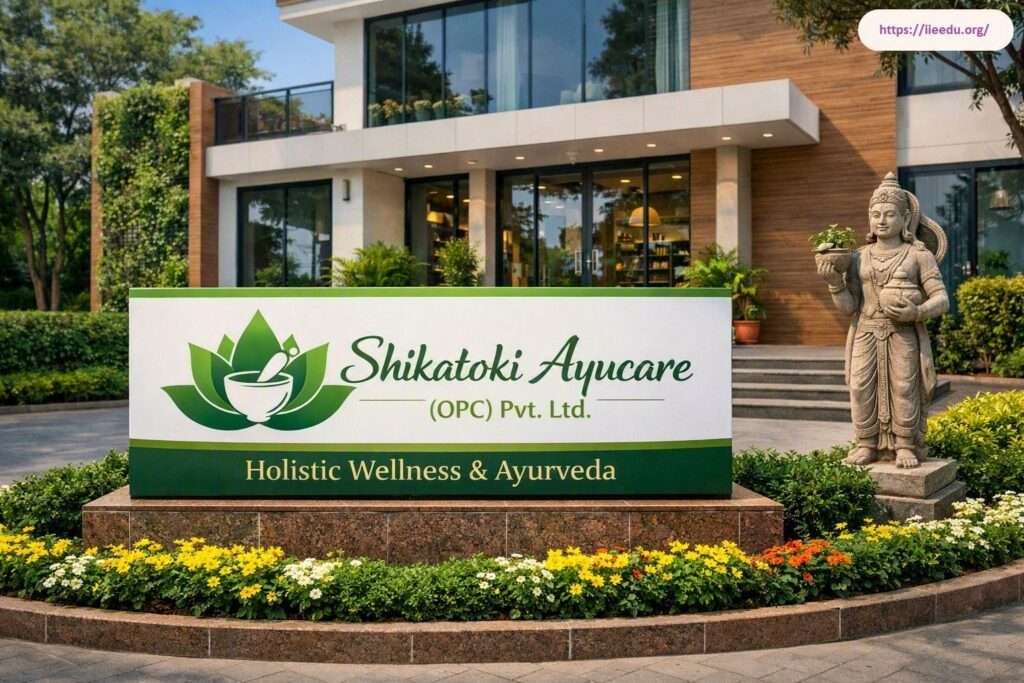
Shikatoki Ayucare (OPC) Pvt. Ltd.
- Shikatoki Ayucare (OPC) Pvt. Ltd.
- Chapter 1 – The Beginning of a Vision
- Chapter 2 – The Decision to Choose Quality
- Chapter 3 – The Certificate and the New Confidence
- Chapter 4 – From Individual Effort to Organizational System
- Chapter 5 – Building Trust One Customer at a Time
- Chapter 6 – The Promoter’s Transformation
- Chapter 7 – Quality as a Foundation for Growth
- Chapter 8 – Facing Challenges and Turning Them into Lessons
- Chapter 9 – The Meaning of Sustainable Growth
- Chapter 10 – A Future Built on Quality
- Take the Next Step Today

Chapter 1 – The Beginning of a Vision
Every successful organization begins with a vision. Some businesses begin with a desire to solve a problem, some with an ambition to serve a particular community, and others with the determination of an entrepreneur who believes that a better service can be created. The story of Shikatoki Ayucare (OPC) Pvt. Ltd. is a story that brings together these elements through a commitment to health-care and personal-care services.
Shikatoki Ayucare (OPC) Pvt. Ltd. was established in Maharashtra at a time when the health-care and personal-care sectors were experiencing continuous changes in customer expectations. The company was incorporated in December 2018, providing a formal platform for its promoter, Saurabh Jagannath Tayade, to develop his entrepreneurial vision. The organization was established as a One Person Company, reflecting the promoter’s direct involvement and personal responsibility for developing the business.
The company’s operating location at Site-3: House No. 1100, Plot No. 326, Above Mahajan Hospital, Sangrampur, Buldhana, Maharashtra – 444202, provided it with a connection to the local community and the surrounding health-care environment. Its declared scope of work was Providing Health-Care & Personal Care Services, an area where trust, responsibility, customer satisfaction and consistency are particularly important.
The early period of a business is rarely easy. A newly established organization has to build its identity while simultaneously understanding its customers, developing its services and establishing reliable methods of operation. For a promoter, this stage requires more than financial investment. It requires patience, confidence, decision-making and the willingness to learn from experience.
For Shikatoki Ayucare, the initial objective was not simply to establish a business presence. The larger objective was to create an organization that customers could approach with confidence.
Health-care and personal-care services are different from ordinary commercial transactions. Customers expect to be treated with respect and care. They expect information to be communicated clearly. They expect services to be provided consistently. When customers share their requirements, they expect the organization to understand their needs and respond appropriately.
This makes quality a fundamental part of the business.
In the beginning, many activities in a small organization naturally depend upon the direct involvement of the promoter. The promoter may communicate with customers, supervise activities, resolve issues, monitor documentation and make operational decisions. This personal involvement can be valuable during the early stages because it allows the promoter to understand the business closely.
However, as the organization begins to develop, a new challenge appears: how can the same level of attention and consistency be maintained when activities increase?
This question became an important part of Shikatoki Ayucare’s development.
A growing organization needs systems. Responsibilities need to be understood. Activities need to be organized. Information needs to be recorded. Customer feedback needs to be considered. Problems need to be identified and corrected. Management needs reliable information to determine whether the organization is moving in the right direction.
The promoter therefore began looking beyond the immediate requirements of running a young company. The focus gradually moved toward creating a structured organization capable of delivering services consistently.
This was the environment in which the decision to pursue ISO 9001:2015 certification became significant.
ISO 9001:2015 provides a framework for establishing a quality-management system that helps organizations consistently meet applicable requirements and enhance customer satisfaction through continual improvement. For Shikatoki Ayucare, adopting such a framework represented an important step in moving from an informal, promoter-driven approach toward a more systematic method of management.
The year 2019 became a major milestone in this journey, when the company received ISO 9001:2015 certification according to the information supplied for this corporate history.
The certification represented more than a document.
For the promoter, it could serve as a declaration of intent: the company wanted quality to become part of its organizational culture.
Quality would not simply mean completing a service. It would mean understanding requirements, following appropriate processes, monitoring performance and looking for opportunities to improve.
This change in thinking was important for the company’s future.
A company can grow quickly without establishing strong systems, but such growth may create difficulties later. If customer requests increase without proper processes, delays can occur. If responsibilities are unclear, mistakes can become more frequent. If feedback is not recorded, management may miss important information. If problems are repeatedly solved without identifying their causes, the same difficulties can return.
A quality-management approach encourages an organization to look at the underlying process.
The question changes from “Who made the mistake?” to “Why did the process allow the mistake to occur, and how can we improve it?”
That change can create a healthier organizational culture.
For Shikatoki Ayucare, the certification journey therefore represented the beginning of a new phase. The promoter’s original entrepreneurial vision was being supported by a structured quality framework. The company had an opportunity to build a reputation based not only on its services but also on its commitment to organized and consistent operations.
The journey ahead would require continuous effort. Certification itself could not guarantee success. The organization would have to maintain its processes, listen to customers, develop its people, respond to problems and continually improve.
But the foundation had been established.
The story of Shikatoki Ayucare was no longer only the story of a newly established company. It was becoming the story of an organization determined to develop with purpose.
From its beginnings in Sangrampur, the company entered its next chapter with a clear lesson: lasting growth begins with a strong foundation, and a strong foundation begins with a commitment to quality.
The ISO 9001:2015 certification of 2019 became an important milestone in that journey. It marked the point at which the company formally embraced a quality-oriented approach and began looking toward the future with greater structure, discipline and confidence.
#ShikatokiAyucare
Chapter 2 – The Decision to Choose Quality
The early success of any organization depends on its ability to transform an idea into a reliable system of service. For Shikatoki Ayucare (OPC) Pvt. Ltd., this transformation became particularly important as the company moved beyond its initial establishment and began considering how it could create a stronger and more professional foundation for future growth.
After establishing the company in Sangrampur, Buldhana, Maharashtra, the promoter, Saurabh Jagannath Tayade, faced a fundamental question: how could a growing organization provide health-care and personal-care services consistently while maintaining customer confidence?
The answer was not simply to work harder. It was to work in a more organized way.
In a small organization, many activities can be managed through direct communication and personal supervision. The promoter may know every customer, every pending activity and every operational difficulty. This approach can work during the early stage, but it becomes increasingly difficult when responsibilities grow.
A company that wants to develop sustainably needs processes that do not depend entirely on one person’s memory or daily supervision.
This realization created the foundation for Shikatoki Ayucare’s decision to adopt a formal quality-management approach.
The decision to pursue ISO 9001:2015 certification in 2019 was therefore an important milestone. ISO 9001:2015 is an internationally recognized quality-management-system standard designed to help organizations consistently provide products and services that meet customer and applicable requirements while enhancing customer satisfaction and pursuing continual improvement.
For Shikatoki Ayucare, the relevance of such a system was closely connected with its scope of work: Providing Health-Care & Personal Care Services.
In health-care and personal-care activities, quality is not limited to the final service. Quality can influence every stage of the customer experience.
It begins when a customer makes an enquiry.
It continues through communication, understanding of requirements, service planning and delivery.
It includes the way information is recorded and maintained.
It also includes what happens after the service has been provided.
If a customer has a concern, how does the organization respond?
If a mistake occurs, how is it corrected?
If the same problem occurs repeatedly, how does management prevent it?
These questions demonstrate why a structured quality-management system can be valuable.
The certification process encouraged the company to look carefully at its own operations. Instead of assuming that existing methods were automatically effective, the organization could examine them systematically.
This examination could include responsibilities, procedures, records, customer feedback, internal monitoring and management review.
For the promoter, this represented a change in leadership perspective.
Entrepreneurship often begins with personal initiative. A promoter sees an opportunity and takes responsibility for pursuing it. But organizational growth requires something more. The entrepreneur must gradually become a system builder.
A system builder asks questions such as:
What should happen?
Who should do it?
How should it be done?
What information should be recorded?
How will we know whether it was successful?
What should happen if something goes wrong?
How can the process be improved?
These questions may appear simple, but together they create organizational discipline.
The ISO journey gave Shikatoki Ayucare an opportunity to establish this discipline.
One important area was customer focus.
Customers are at the center of every service organization. A business can have excellent internal procedures, but if it does not understand and respond to customer requirements, its quality system has limited value.
Therefore, customer expectations needed to be understood and respected.
The company could strengthen communication and develop a more consistent approach to handling enquiries and service requirements. Customer feedback could be treated as useful information rather than merely as praise or criticism.
Positive feedback could show what the organization was doing well.
Negative feedback could reveal areas for improvement.
Complaints could become opportunities to identify weaknesses in the process.
This created a new mindset.
Instead of viewing quality as something that happened at the end of service delivery, the organization could begin viewing quality as something created throughout the entire process.
Another important aspect was documentation.
Documentation can sometimes be misunderstood as unnecessary paperwork. In a well-managed quality system, however, records provide organizational memory.
When information is documented properly, the organization does not have to rely solely on individual recollection.
Records can help management understand what happened, identify trends and make better decisions.
For a developing company, this can be especially valuable.
As responsibilities increase, documentation creates continuity.
An employee who joins the organization later can understand established processes. A manager can review previous information. The promoter can make decisions based on evidence rather than assumptions.
The certification process also encouraged the company to think about continual improvement.
Improvement does not always require a major transformation.
Sometimes improvement means reducing an unnecessary step.
Sometimes it means making communication clearer.
Sometimes it means improving record-keeping.
Sometimes it means providing additional training.
Sometimes it means responding more quickly to customer concerns.
When such improvements are repeated over time, they can significantly strengthen an organization.
For Shikatoki Ayucare, the decision to pursue certification therefore represented an investment in the future.
The certificate could provide external recognition, but the more important benefit was the internal discipline required to maintain the quality-management system.
The promoter understood that certification could not replace hard work.
It could not guarantee customers.
It could not eliminate competition.
It could not automatically create growth.
Instead, it could provide a framework within which the organization could pursue growth responsibly.
This distinction became essential.
The company was not choosing ISO certification simply because it wanted a certificate to display. It was choosing a structured approach because it wanted to become a more dependable organization.
The decision also reflected confidence.
A young company willing to subject its processes to formal assessment demonstrates a willingness to be examined.
It accepts that improvement requires evaluation.
It accepts that processes can be strengthened.
It accepts that quality is a continuous responsibility.
The year 2019 therefore became more than a certification year.
It became a turning point in the company’s organizational thinking.
The promoter’s original vision remained the same—to develop a meaningful business in the health-care and personal-care services sector—but the method of pursuing that vision became more structured.
The company was beginning to move from individual effort toward organized performance.
That transition created the foundation for the next stage: using quality not only to improve internal operations, but also to build confidence among customers, stakeholders and the wider community.
#ISO9001
Chapter 3 – The Certificate and the New Confidence
The year 2019 became an important milestone in the journey of Shikatoki Ayucare (OPC) Pvt. Ltd. With the achievement of ISO 9001:2015 certification, the organization entered a new phase of its development. The certification represented an external recognition of the company’s commitment to establishing a structured quality-management approach for its declared scope of Providing Health-Care & Personal Care Services.
For a young organization, receiving a quality certification can be an important moment. It provides an opportunity to communicate a clear message to customers, business associates and other stakeholders: the organization is serious about the way it operates.
However, the real value of certification does not come from the certificate alone.
A certificate can be framed and displayed, but quality must be demonstrated through everyday actions.
For Shikatoki Ayucare, the certification became a reminder that the company had accepted a continuing responsibility. The organization needed to maintain the processes associated with its quality-management system and continually look for ways to improve.
This changed the meaning of quality within the company.
Before a formal quality system is established, a small organization may depend heavily on the personal knowledge and supervision of its promoter. The promoter knows customers, understands daily activities and directly resolves most problems.
After adopting a structured quality-management approach, however, the organization can begin developing systems that make responsibilities and expectations clearer.
This transition was significant for Shikatoki Ayucare.
The promoter, Saurabh Jagannath Tayade, could increasingly focus not only on individual operational matters but also on the overall development of the organization. Quality became a management responsibility rather than a task limited to one person.
One of the first changes associated with this mindset was greater attention to consistency.
Customers may have different needs, but they generally expect a dependable experience. They expect information to be communicated properly. They expect their requirements to be understood. They expect services to be delivered responsibly.
Consistency is therefore a major component of customer confidence.
If an organization provides an excellent experience once but an inconsistent experience the next time, customer trust can weaken. A quality-management system encourages the organization to reduce unnecessary variation and establish appropriate processes.
For Shikatoki Ayucare, this principle was particularly relevant because of its involvement in health-care and personal-care services.
People approach such organizations with expectations that go beyond price.
They want professionalism.
They want responsiveness.
They want respectful communication.
They want confidence that their requirements are being handled appropriately.
The company’s ISO 9001:2015 certification provided a framework for supporting these expectations.
Another important change was the growing importance of records and documented information.
Documentation can help an organization preserve knowledge. Instead of relying entirely on memory, the company can use records to understand activities, identify issues and review performance.
For management, this creates greater visibility.
A promoter cannot improve what cannot be understood or measured effectively. When information is available, management can ask better questions.
Are customers satisfied?
Where are delays occurring?
What types of problems are being reported?
Which processes require improvement?
Are corrective actions effective?
What training is required?
These questions can turn routine information into management knowledge.
The certification process therefore encouraged Shikatoki Ayucare to look at its activities from a wider perspective.
A service was no longer simply an activity to be completed.
It became part of a process.
A customer enquiry was connected to communication.
Communication was connected to service requirements.
Service requirements were connected to delivery.
Delivery was connected to customer feedback.
Feedback was connected to improvement.
This chain created a more systematic understanding of the business.
The organization also had an opportunity to develop a stronger culture of accountability.
When responsibilities are clearly understood, employees and associates know what is expected of them. When processes are documented, activities become less dependent on individual interpretation. When performance is reviewed, management can identify areas requiring attention.
Accountability does not mean creating fear.
Instead, it can create clarity.
People perform better when they understand their responsibilities and have the resources and information needed to perform them.
This became another important lesson from the certification journey.
The ISO certificate also had significance outside the organization.
In a competitive market, customers and business partners often look for signs of professionalism. Certification can help demonstrate that an organization has adopted a recognized quality-management framework.
For Shikatoki Ayucare, this could contribute to a stronger professional image.
However, the promoter understood that reputation had to be supported by actual performance.
A company cannot depend indefinitely on a certificate if its service quality does not meet customer expectations.
Therefore, the certification created an obligation to continue improving.
This understanding prevented the certificate from becoming merely a marketing symbol.
Instead, it could serve as a foundation for trust.
Trust develops through repeated experiences.
When customers receive consistent service, they gain confidence.
When complaints are handled responsibly, confidence increases.
When the organization responds to changing requirements, customers see adaptability.
When management takes improvement seriously, stakeholders recognize professionalism.
Over time, these experiences can contribute to a stronger reputation.
For the promoter, this was an important realization: quality creates confidence, and confidence creates opportunities for growth.
The company could therefore begin thinking beyond immediate transactions.
A satisfied customer might return.
A satisfied customer might recommend the organization.
A recommendation might bring another customer.
A positive reputation could strengthen relationships within the local community.
Growth could consequently emerge from the accumulation of small successes.
This was not a promise of instant expansion. Rather, it was the beginning of a sustainable approach.
The certification also encouraged the company to think about the future.
What would the organization look like several years later?
What additional capabilities would be needed?
How could services be improved?
How could customer expectations be understood more effectively?
How could technology support the organization?
How could employees become more capable?
These questions helped move management from short-term thinking toward strategic thinking.
The ISO 9001:2015 certification of 2019 was therefore both an achievement and a responsibility.
It represented the completion of one stage, but it also opened another.
The company had established a quality foundation.
Now it needed to build upon that foundation.
The certificate could create visibility, but only performance could create lasting trust.
The system could establish processes, but only people could bring those processes to life.
And the promoter could establish the vision, but the organization’s continuing success would depend on turning that vision into everyday practice.
For Shikatoki Ayucare, this was the beginning of a new confidence—not the confidence that everything would always be perfect, but the confidence that the organization had a structured foundation from which it could learn, improve and grow.
#QualityManagement
Chapter 4 – From Individual Effort to Organizational System

The achievement of ISO 9001:2015 certification in 2019 marked an important transition in the journey of Shikatoki Ayucare (OPC) Pvt. Ltd. The company had moved beyond the stage of simply establishing itself and had begun developing a more structured approach to its health-care and personal-care services.
The next challenge was to transform the principles of quality into an organizational system.
In the early days of a small company, the promoter often becomes the center of almost every activity. Decisions are made personally, customers may communicate directly with the promoter, operational problems are solved immediately, and employees or associates depend heavily on the promoter’s knowledge and instructions.
This approach has advantages.
It allows quick decision-making.
It creates close relationships with customers.
It gives the promoter a detailed understanding of daily operations.
However, there is also a limitation. As the organization grows, it becomes increasingly difficult for one person to supervise everything.
For Shikatoki Ayucare, the adoption of a quality-management system provided an opportunity to address this challenge.
The company could begin defining processes, responsibilities and methods of working more clearly. Instead of depending entirely on personal instructions, the organization could establish procedures that provided consistency.
This was an important step toward organizational maturity.
The promoter, Saurabh Jagannath Tayade, remained responsible for the overall direction of the company, but the organization’s success could increasingly depend upon systems rather than individual memory.
This distinction is critical.
A business that depends entirely on one person may function effectively while that person is present. A business supported by documented processes, trained people and clearly defined responsibilities has greater potential to continue functioning consistently even when individual circumstances change.
The ISO 9001:2015 framework encouraged this kind of process-oriented thinking.
The organization could consider its activities as connected processes rather than isolated tasks.
A customer enquiry could be considered the beginning of a service process.
Understanding the customer’s requirements could become the next step.
Service planning and execution would follow.
Customer feedback could then provide information about the outcome.
If a problem occurred, corrective action could be initiated.
Finally, management could review the experience and identify opportunities for improvement.
This process approach created a more complete view of the organization.
It also helped clarify responsibilities.
When people know exactly what is expected of them, confusion can be reduced. When procedures are understood, different individuals can approach similar situations more consistently. When records are maintained, information can be reviewed later.
Documentation therefore became an important part of organizational development.
The purpose of documentation was not simply to create files.
The deeper purpose was to preserve knowledge.
Consider a situation in which an employee discovers a useful method for handling a recurring customer requirement. If that knowledge remains only with the employee, the organization may lose it when the person leaves.
If the method is evaluated, documented and incorporated into an appropriate process, it becomes organizational knowledge.
This is how small organizations gradually become stronger institutions.
For Shikatoki Ayucare, the same principle could apply to customer communication, service activities, internal responsibilities and improvement actions.
The organization could learn from experience and convert those lessons into better ways of working.
Another important development was the changing role of management.
The promoter no longer needed to think only about solving individual problems. Management could increasingly focus on identifying why problems occurred.
This represents a major difference between reactive management and process management.
Reactive management asks:
“How do we fix this problem?”
Process management asks:
“Why did this problem happen, and what can we change to prevent it from happening again?”
The second question can lead to more sustainable improvement.
Suppose a customer experiences a delay.
The immediate response may be to apologize and complete the pending activity.
But management can go further.
Was the responsibility unclear?
Was information missing?
Was there a communication gap?
Was the workflow inefficient?
Was there insufficient training?
Was the expected response time not defined?
By examining these questions, the organization can address the underlying cause.
This approach can reduce repeated problems and improve customer confidence.
It can also reduce the pressure placed on the promoter.
If the same issue is repeatedly solved personally by the promoter, the organization remains dependent on him.
If the underlying process is improved, the organization becomes stronger.
This was an important part of the promoter’s own transformation.
The role of an entrepreneur changes as a company develops.
At the beginning, the promoter must create.
Later, the promoter must organize.
Eventually, the promoter must lead.
Leadership means creating an environment in which other people can perform effectively.
For Shikatoki Ayucare, this meant creating clarity around expectations and encouraging a culture of responsibility.
Quality could not remain the responsibility of one person.
Every person involved in service delivery had a role.
Customer-facing personnel had a role in communication.
Operational personnel had a role in following processes.
Management had a role in providing resources and direction.
Everyone had a role in identifying opportunities for improvement.
This shared responsibility created the possibility of a stronger quality culture.
The company could also begin using reviews and performance information to make decisions.
Rather than relying entirely on intuition, management could examine customer feedback, operational issues and other available information.
This allowed decisions to become more evidence-based.
For a developing organization, this is valuable.
Good management is not simply about making many decisions. It is about making better decisions.
The quality-management system provided a framework that could support this process.
At the same time, the company needed to avoid becoming overly rigid.
Health-care and personal-care services involve people, and people do not always fit perfectly into standardized situations.
Customers can have individual requirements.
Unexpected circumstances can arise.
Therefore, the objective was not to remove flexibility.
The objective was to create controlled flexibility.
The organization could maintain consistent quality principles while responding appropriately to individual customer needs.
This balance between standardization and personal attention was essential.
The company’s journey therefore moved from individual effort toward organizational capability.
The promoter’s personal commitment remained important, but it was increasingly supported by processes, records, responsibilities and a culture of improvement.
The result was a stronger foundation for future growth.
Shikatoki Ayucare was no longer simply asking how to complete today’s work.
It was beginning to ask how to build a system capable of delivering quality tomorrow, next month and in the years ahead.
That was the deeper significance of the post-certification period.
The ISO 9001:2015 certificate had helped open the door.
But organizational systems would determine how far the company could travel through it.
The journey from individual effort to organizational system was therefore not merely an administrative change.
It was a transformation in the way the company thought, worked and prepared for the future.
And it created the foundation for the next important stage: turning internal discipline into lasting customer trust.
#HealthcareServices
Chapter 5 – Building Trust One Customer at a Time
Courtesy: iso certification worldwide
The real strength of a service organization is ultimately measured by the trust it builds with its customers. Buildings, certificates, procedures and business plans may create the foundation of an organization, but it is the experience of customers that determines whether the organization develops a lasting reputation. For Shikatoki Ayucare (OPC) Pvt. Ltd., the period following its ISO 9001:2015 certification became an important stage in developing a stronger culture of customer focus.
The company’s declared scope of work, Providing Health-Care & Personal Care Services, placed customer relationships at the center of its activities. In these sectors, customers expect more than a simple commercial transaction. They expect understanding, responsibility, appropriate communication and dependable service.
For this reason, the promoter, Saurabh Jagannath Tayade, had an important responsibility. The company needed to ensure that the quality principles adopted through its ISO 9001:2015 framework were reflected in the actual experience of customers.
The first step toward building trust was understanding that every customer interaction mattered.
A customer’s first interaction with an organization may be a telephone call, enquiry, consultation, service request or personal visit. Although the interaction may appear routine to the organization, it can strongly influence the customer’s perception.
If the customer receives clear information and respectful attention, confidence can begin to develop.
If communication is confusing or delayed, uncertainty can increase.
Therefore, customer focus had to become part of everyday operations.
The quality-management approach encouraged the organization to view customer requirements systematically. Instead of assuming that every customer wanted exactly the same experience, the company could pay attention to individual requirements while maintaining consistent quality standards.
This balance was important.
Standard processes helped ensure consistency, while personal attention helped ensure that customers felt understood.
Another important element of trust was reliability.
Customers want to know that an organization will do what it says it will do. If a service is promised, the customer expects the service to be delivered responsibly. If additional information is required, the customer expects communication. If a concern arises, the customer expects an appropriate response.
Reliability is therefore built through repeated actions.
One successful interaction may create a positive impression.
Many successful interactions create a reputation.
The ISO 9001:2015 approach could support this consistency by encouraging the company to define processes and monitor performance.
For Shikatoki Ayucare, this meant that customer satisfaction could be treated as an ongoing management objective rather than an occasional question.
Customer feedback could become an important source of information.
Positive feedback could indicate that existing methods were working effectively.
Suggestions could identify opportunities for improvement.
Complaints could reveal weaknesses.
The organization could then analyze the information and decide what action was necessary.
This created a valuable cycle.
Listen. Understand. Respond. Improve.
A complaint, in particular, could be viewed differently under a mature quality culture.
Some organizations treat complaints as threats to their reputation. A quality-oriented organization can treat complaints as opportunities to understand where its processes may be failing.
For example, if customers repeatedly experience delays in receiving information, management should not simply respond to each individual complaint. It should ask why the delay is happening.
Perhaps responsibility is unclear.
Perhaps information is not available at the correct stage.
Perhaps the communication process is inefficient.
Perhaps employees need additional training.
Perhaps the expected response time has not been clearly defined.
Identifying the cause can help prevent recurrence.
This approach demonstrates respect for the customer.
It tells the customer that the organization is not merely interested in closing a complaint; it is interested in learning from the experience.
Over time, such behavior can strengthen trust.
The promoter’s leadership was particularly important in developing this culture.
Employees observe what management considers important.
If management treats customer feedback seriously, employees understand that customer satisfaction is a priority.
If management ignores feedback, employees may eventually do the same.
Therefore, quality culture begins at the top but must become shared throughout the organization.
Training and communication can help employees understand their responsibilities.
An employee who understands the company’s quality objectives is better positioned to contribute to them.
An employee who knows how to handle a customer concern can respond more confidently.
An employee who understands the importance of accurate records can help maintain organizational reliability.
Thus, customer satisfaction is connected to employee capability.
Another factor was the company’s local presence.
Operating in Sangrampur, Buldhana, gave Shikatoki Ayucare an opportunity to develop relationships within its surrounding community. In local markets, reputation can spread through personal recommendations.
A satisfied customer may recommend a service to a family member.
A family member may recommend it to a friend.
A friend may become another customer.
In this way, trust can create organic business development.
The promoter therefore had reason to see every satisfied customer as more than an individual transaction.
A satisfied customer could become an ambassador for the organization.
This does not mean that every customer would automatically recommend the company. Rather, it highlights the importance of consistently positive experiences.
The organization could strengthen this process by ensuring that its service standards remained consistent as activities increased.
Growth can sometimes create pressure.
More customers can mean more communication.
More services can mean more complexity.
More responsibilities can create opportunities for confusion.
Therefore, customer focus had to remain strong even as the organization developed.
This was one of the major benefits of having a structured quality-management system.
It reminded the organization that growth should not come at the expense of service quality.
The company could pursue expansion while continuing to monitor customer expectations and performance.
The promoter’s philosophy could therefore evolve from simply attracting customers toward building long-term relationships.
This was a more sustainable approach.
A customer relationship can create recurring opportunities.
It can provide feedback.
It can strengthen reputation.
It can help the company understand changing needs.
It can also help management identify new opportunities for service development.
Customer trust therefore became connected with business growth.
The relationship was simple:
Better understanding could lead to better service.
Better service could lead to greater satisfaction.
Greater satisfaction could lead to stronger trust.
Stronger trust could lead to loyalty and recommendations.
Loyalty and recommendations could support sustainable growth.
This cycle helped demonstrate why quality management was not merely an internal administrative exercise.
Its effects could reach directly into the marketplace.
For Shikatoki Ayucare, the post-certification period was therefore a period of building confidence one customer at a time.
The company did not need to become successful through one dramatic event.
It could build its reputation gradually through thousands of small acts of professionalism.
A clear response.
A respectful conversation.
A properly maintained record.
A carefully delivered service.
A timely solution.
A willingness to listen.
Each action could strengthen the organization’s reputation.
The ISO certificate had provided recognition of a quality-management approach.
Customer experience would determine whether that approach became meaningful in practice.
The company therefore entered its next stage with an important lesson: quality may be documented in a system, but trust is built through people.
For Shikatoki Ayucare, building that trust became one of the most important foundations for future growth.
#PersonalCareServices
Chapter 6 – The Promoter’s Transformation
Behind every growing organization there is a story of leadership. Buildings, documents, systems and certificates are important, but they do not create themselves. They are shaped by people who make decisions, accept responsibility and continue working toward a vision even when the path ahead is uncertain. For Shikatoki Ayucare (OPC) Pvt. Ltd., the journey after ISO 9001:2015 certification was closely connected with the development of its promoter, Saurabh Jagannath Tayade.
The establishment of the company represented the beginning of an entrepreneurial journey. As the promoter, Mr. Tayade carried the responsibility of converting an idea into a functioning organization in the field of health-care and personal-care services. During the early stage, direct personal involvement was naturally important. A promoter of a young company often performs many roles simultaneously—planning activities, communicating with customers, supervising operations, solving problems and making decisions about the future.
This direct involvement can help a company establish itself. However, as the organization develops, leadership must also develop.
The achievement of ISO 9001:2015 certification in 2019 provided an opportunity for this transformation. The certification encouraged the company to think in terms of systems, processes, responsibilities, customer requirements and continual improvement.
For the promoter, this meant learning to look at the organization from a wider perspective.
Instead of asking only, “How can I solve this problem?” the question could become, “How can the organization prevent this problem from happening again?”
Instead of asking, “Who can complete this task?” management could ask, “What process should ensure that this task is completed consistently?”
Instead of relying entirely on personal experience, the company could begin relying more strongly on documented knowledge, records and performance information.
This was a significant change in leadership thinking.
Entrepreneurship is often associated with speed and flexibility. A promoter sees an opportunity and acts quickly. Quality management introduces another dimension: discipline.
The challenge is to combine both.
An organization must remain entrepreneurial enough to identify opportunities but disciplined enough to deliver consistently.
For Shikatoki Ayucare, this balance became increasingly important.
The promoter could use the quality-management framework to create clearer expectations for the organization. Responsibilities could be defined. Processes could be reviewed. Customer feedback could be considered. Problems could be analyzed. Improvement opportunities could be discussed.
This did not reduce the promoter’s importance.
Instead, it changed the nature of leadership.
The promoter increasingly became the person responsible for creating direction and building organizational capability.
A strong leader does not attempt to perform every task personally. A strong leader creates conditions in which other people can perform effectively.
This means providing appropriate resources.
It means communicating expectations.
It means encouraging responsibility.
It means developing people.
It means reviewing performance.
And it means accepting that improvement sometimes requires changing established methods.
For a small organization, this can be challenging.
Promoters often become personally attached to the ways in which their company operates. Methods that worked during the early years may feel familiar and comfortable. But growth can require change.
A process that worked when there were only a few customers may become inefficient when customer activity increases.
A communication method that worked informally may become difficult to manage when more people become involved.
A promoter who personally remembered every detail may eventually need a reliable record-management system.
These changes are not signs that the old methods were wrong. They are signs that the organization is developing.
The ISO 9001:2015 philosophy encouraged this development.
One of its important principles is continual improvement. For the promoter, continual improvement could become a leadership habit.
After every problem, the organization could ask what it had learned.
After every customer complaint, it could ask whether a process needed strengthening.
After every successful improvement, it could consider whether the lesson could be applied elsewhere.
This approach transformed experience into organizational knowledge.
The promoter also had to recognize the importance of employees and associates.
A quality-management system cannot succeed through management instructions alone. People must understand their roles and contribute to the organization’s objectives.
Training therefore became an important part of development.
A trained employee can perform tasks with greater confidence.
An informed employee can communicate more effectively.
An employee who understands quality expectations can identify problems earlier.
An employee who feels responsible for improvement can contribute ideas.
Thus, leadership and employee development became closely connected.
Another important change was the promoter’s relationship with customers.
In the early stage, customer relationships may be highly personal. As the company grows, management must ensure that the same customer-focused attitude exists throughout the organization.
The promoter’s values therefore need to become organizational values.
If the promoter believes customers should be treated respectfully, that principle should be reflected in procedures and employee behavior.
If the promoter believes in timely responses, the organization should develop appropriate processes to support timely responses.
If the promoter believes in continuous improvement, employees should be encouraged to identify opportunities for improvement.
This is how individual leadership becomes organizational culture.
The promoter’s transformation was therefore not simply about acquiring management skills. It was about creating an organization capable of carrying forward his vision.
The company needed to become less dependent on individual effort and more capable of collective performance.
This also allowed the promoter to think more strategically.
Instead of spending all his time on routine issues, he could focus on questions about the future.
What services could be developed?
How could customer needs be better understood?
What technology could improve operations?
What capabilities should employees develop?
What partnerships could strengthen the organization?
How could the company grow without compromising quality?
These questions are the questions of a strategic leader.
The journey was not necessarily easy.
Every transition creates challenges.
Delegation requires trust.
Documentation requires discipline.
Process improvement requires patience.
Change can create resistance.
Growth can create uncertainty.
But leadership is demonstrated through the ability to navigate these challenges while maintaining direction.
The ISO certification became an important milestone in this transformation because it encouraged the promoter to see quality as a management responsibility rather than simply an operational task.
The certificate represented external recognition, but the deeper achievement was internal.
The company was developing a new way of thinking.
Quality was becoming part of decision-making.
Customer satisfaction was becoming a management objective.
Processes were becoming organizational assets.
Employees were becoming contributors to improvement.
The promoter was becoming not only the founder of the company, but also the architect of its organizational culture.
This transformation created a stronger foundation for sustainable growth.
A company can survive for some time through individual effort.
To grow sustainably, however, it needs systems, people and leadership.
Shikatoki Ayucare’s post-certification journey therefore demonstrated an important lesson: the growth of a company often begins with the growth of its leader.
As the organization learned to manage quality systematically, its promoter also learned to lead systematically.
The entrepreneurial vision remained the driving force, but it was now supported by greater discipline, clearer processes and a stronger understanding of organizational responsibility.
The next stage of the journey would be to use this stronger foundation to create measurable and sustainable organizational growth.
#CustomerSatisfaction
Chapter 7 – Quality as a Foundation for Growth
The journey of Shikatoki Ayucare (OPC) Pvt. Ltd. after receiving ISO 9001:2015 certification in 2019 entered a new and important stage: converting quality from a formal management requirement into a practical foundation for growth. The company had established itself in the field of health-care and personal-care services, and the next challenge was to ensure that growth could take place without compromising the standards and customer confidence the organization was working to establish.
For the promoter, Saurabh Jagannath Tayade, this was an important management lesson. Growth is valuable only when an organization has the capability to manage it.
A company may receive more enquiries, serve more customers or expand its activities, but if its internal processes are not strong enough, rapid growth can create new problems. Delays can increase, communication can become difficult, responsibilities can become unclear and customer satisfaction can decline.
Therefore, the company needed to understand that quality and growth were not separate objectives. They needed to support one another.
The ISO 9001:2015 quality-management approach provided a framework for this connection.
One of the most important concepts was continual improvement. Improvement could be large or small, but it needed to become a regular part of organizational thinking.
The company could begin by asking simple questions.
What is working well?
What is not working well?
Where are customers experiencing difficulties?
Which activities take unnecessary time?
Are responsibilities clear?
Are employees receiving appropriate information and training?
Are records helping management make decisions?
What can be done differently?
These questions helped turn everyday operations into opportunities for improvement.
For example, if the organization discovered that customers were repeatedly asking for clarification about a particular service, management could examine its communication process. Perhaps information needed to be presented more clearly. Perhaps employees required additional guidance. Perhaps customer information materials could be improved.
A small change could make a large difference when repeated across many customer interactions.
The same principle could apply to internal activities.
If employees spent unnecessary time searching for information, document management could be improved.
If responsibilities overlapped, the workflow could be clarified.
If a recurring error appeared, the organization could investigate its root cause.
If customers experienced delays, management could examine the process and identify the point at which the delay occurred.
These improvements could increase efficiency while also strengthening customer satisfaction.
Quality therefore became a practical business tool.
Another important aspect of the company’s development was performance monitoring.
A quality-management system encourages organizations to evaluate whether their processes are producing the intended results. For Shikatoki Ayucare, this meant that management could increasingly look at available information when making decisions.
Customer feedback could reveal satisfaction levels.
Complaints could identify weaknesses.
Process records could reveal recurring issues.
Management reviews could highlight priorities.
Employee observations could reveal practical opportunities.
Together, these sources of information could help the promoter make more informed decisions.
This was a significant improvement over relying entirely on intuition.
Entrepreneurial intuition remains valuable, especially for identifying opportunities. But when intuition is combined with evidence, management decisions can become stronger.
The company could therefore begin developing a culture in which decisions were supported by information wherever possible.
This also helped create accountability.
When objectives are defined and performance is reviewed, people have a clearer understanding of what the organization expects.
Employees can understand how their responsibilities contribute to broader company goals.
Managers can identify where support is needed.
Leadership can recognize successful improvements.
The organization becomes more transparent to itself.
For a growing company, this transparency is valuable.
It can prevent small issues from becoming major problems.
Another area of importance was employee capability.
Processes are only as effective as the people who operate them.
A well-written procedure cannot produce quality if employees do not understand it.
Therefore, training and awareness became important parts of organizational development.
Employees could be encouraged to understand not only what they were expected to do but why their work mattered.
A person handling customer communication, for example, is contributing directly to the organization’s reputation.
A person maintaining records is supporting management’s ability to make decisions.
A person identifying a process problem is contributing to continual improvement.
When employees understand these connections, their sense of responsibility can increase.
This creates a culture in which quality becomes everyone’s responsibility.
The promoter also needed to ensure that growth did not become disconnected from the company’s core purpose.
Shikatoki Ayucare’s scope involved health-care and personal-care services. Therefore, any development had to remain aligned with customer needs and responsible service delivery.
Expansion should not mean accepting every opportunity regardless of capability.
Instead, the organization needed to consider whether it had sufficient resources, competent people, appropriate processes and the ability to maintain quality.
This created a more sustainable approach to growth.
The company could pursue opportunities that strengthened its capabilities while being careful not to overextend itself.
Such discipline is particularly important for smaller organizations.
A business that grows faster than its systems can support may eventually face operational pressure.
A business that strengthens its systems alongside its growth has a better chance of maintaining control.
This was one of the most valuable lessons of the post-certification period.
The organization therefore began to see quality not as a cost but as an investment.
Good processes could reduce waste.
Clear responsibilities could reduce confusion.
Customer feedback could prevent repeated mistakes.
Training could improve performance.
Documentation could preserve organizational knowledge.
Continual improvement could increase efficiency.
Together, these factors could contribute to sustainable development.
The relationship between quality and growth became increasingly clear.
Quality creates consistency.
Consistency creates confidence.
Confidence strengthens customer relationships.
Strong customer relationships support growth.
Growth creates new opportunities for further improvement.
This cycle could become a powerful foundation for the company’s future.
However, the promoter also understood that improvement was never complete.
Markets change.
Customers change.
Technology changes.
Employees change.
Business conditions change.
Therefore, a quality system must also evolve.
A process that works today may need modification tomorrow.
A successful organization is not one that believes it has found a perfect method. It is one that remains willing to learn and improve.
For Shikatoki Ayucare, this mindset became increasingly important as the company looked beyond its initial certification milestone.
The ISO 9001:2015 certification had provided structure.
The company’s people provided effort.
The promoter provided leadership.
Customers provided feedback.
Continual improvement connected all of these elements.
The result was a stronger foundation for sustainable growth.
The company was learning that growth should not simply be measured by becoming larger. It should also be measured by becoming more capable, more organized, more responsive and more reliable.
That was the real meaning of quality as a foundation for growth.
The certificate had opened the door to a more systematic way of working.
#ContinualImprovement
Chapter 8 – Facing Challenges and Turning Them into Lessons
Courtesy: indiaspecial
Every business, regardless of its size or sector, encounters unexpected situations, changing customer expectations, operational difficulties and moments of uncertainty. For Shikatoki Ayucare (OPC) Pvt. Ltd., the period following its ISO 9001:2015 certification in 2019 was not simply a period of progress. It was also a period of learning how to respond to challenges in a more organized and responsible manner.
The company’s scope of work, Providing Health-Care & Personal Care Services, required continuous attention to customer requirements and service quality. As the organization developed, it needed to ensure that its systems were capable of responding to changing circumstances without losing focus on its core commitment to quality.
The promoter, Saurabh Jagannath Tayade, understood an important principle of business leadership: challenges cannot always be avoided, but they can be managed.
The ISO 9001:2015 quality-management approach provided a useful way of thinking about problems. Instead of treating every difficulty as an isolated incident, the organization could examine the underlying causes and consider how similar problems might be prevented in the future.
This created a shift from reaction to learning.
Imagine that a customer experiences a delay. The immediate responsibility is to resolve the customer’s problem. But once the immediate situation is addressed, management can ask a more important question:
Why did the delay occur?
Perhaps the responsibility was unclear.
Perhaps the required information was not available.
Perhaps communication between two activities was inadequate.
Perhaps an employee required additional training.
Perhaps the existing process was inefficient.
Finding the underlying cause can lead to a stronger solution.
This approach became an important part of the company’s quality culture.
A correction addresses the immediate problem.
A corrective action seeks to address the cause.
Continual improvement looks at how the overall system can become stronger.
These three ideas helped the organization develop a more mature approach to challenges.
The company also had to recognize that customer expectations could change over time.
A method that satisfied customers in the early stages of the business might not always be sufficient as the organization developed. Customers may expect faster communication, clearer information, greater convenience or improved responsiveness.
Therefore, listening became essential.
Customer feedback could provide an early warning about changing expectations.
Positive feedback could confirm that certain processes were effective.
Suggestions could indicate new opportunities.
Complaints could reveal weaknesses.
Instead of fearing negative feedback, the organization could use it as a source of information.
This attitude required leadership.
Employees must feel that reporting problems will lead to improvement rather than unnecessary blame. If employees hide mistakes because they are afraid of criticism, management loses valuable information.
A healthy quality culture encourages people to identify issues early.
An identified problem can be investigated.
An investigated problem can be corrected.
A corrected problem can lead to prevention.
Prevention can strengthen the organization.
This cycle can improve resilience.
Resilience became particularly important as the company developed.
A resilient organization is not one that never experiences difficulties. It is an organization that can respond to difficulties without losing its direction.
For Shikatoki Ayucare, this meant maintaining the principles of quality even when circumstances were challenging.
The company needed to continue focusing on customers.
It needed to maintain appropriate records.
It needed to review its processes.
It needed to communicate responsibilities.
It needed to identify areas for improvement.
The promoter’s role was to provide stability and direction.
During challenging periods, employees often look toward leadership for clarity. A promoter who remains focused on quality can help maintain organizational confidence.
Leadership also means recognizing when existing methods are no longer effective.
This can be difficult.
People naturally become comfortable with familiar processes.
Changing a process may require additional effort.
Employees may initially question why a new method is necessary.
However, improvement often requires change.
The organization therefore had to create a balance between stability and adaptability.
Core principles could remain stable while methods could evolve.
Customer focus could remain constant while communication tools changed.
Quality expectations could remain strong while processes became more efficient.
The company’s approach to technology also became relevant.
As businesses develop, digital tools can support communication, documentation, customer management and performance monitoring. Technology can reduce repetitive work and make information more accessible.
However, technology by itself does not solve organizational problems.
A poorly designed process can remain inefficient even after being digitized.
Therefore, the organization first needed to understand the process and then determine whether technology could improve it.
This process-oriented thinking was consistent with the quality-management philosophy.
The company also had to deal with competition.
Health-care and personal-care services can be competitive environments. Customers have choices, and organizations must continually demonstrate their value.
For Shikatoki Ayucare, quality could become an important differentiating factor.
A competitor might offer a similar service, but consistent processes, customer responsiveness and professional service can strengthen customer confidence.
This did not mean that certification alone could create competitive advantage.
The real advantage came from applying quality principles in daily operations.
The ISO certificate could communicate commitment.
Actual performance had to demonstrate it.
This distinction became increasingly important.
The promoter therefore had to ensure that the organization did not become complacent after receiving certification.
Certification was not permission to stop improving.
It was a reason to continue improving.
Every new challenge could become a lesson.
Every lesson could become knowledge.
Every improvement could strengthen the company.
Over time, these small lessons could accumulate into organizational experience.
That experience became one of the company’s most valuable assets.
A young organization may have limited resources, but it can build knowledge rapidly if it learns systematically.
The ability to learn from mistakes can sometimes be more valuable than avoiding every mistake.
For Shikatoki Ayucare, the post-certification period therefore became a practical education in resilience.
The company learned that problems should be investigated rather than ignored.
It learned that feedback should be heard rather than feared.
It learned that processes should evolve rather than remain unchanged.
It learned that employees should participate in improvement rather than simply follow instructions.
And it learned that leadership means maintaining direction while adapting to circumstances.
These lessons strengthened the company’s foundation for the future.
The journey was no longer simply about obtaining recognition.
It was about developing the ability to respond.
In business, challenges are inevitable.
What distinguishes a strong organization is its response.
For Shikatoki Ayucare, the ISO 9001:2015 quality-management philosophy provided a structured way to turn difficulties into opportunities for learning and improvement.
The result was a more resilient way of thinking.
The company did not need to claim that every challenge had disappeared.
Instead, it could demonstrate something more meaningful: a willingness to understand challenges, respond responsibly and improve continuously.
That became one of the most important lessons of the journey.
Challenges tested the organization, but learning from those challenges helped strengthen it.
And with every lesson, Shikatoki Ayucare moved one step closer to building an organization capable of sustainable and responsible growth.
#SustainableGrowth
Chapter 9 – The Meaning of Sustainable Growth
For Shikatoki Ayucare (OPC) Pvt. Ltd., the journey following its ISO 9001:2015 certification in 2019 was not simply about increasing business activity. It was about understanding what meaningful and sustainable growth should look like. The company had established itself in the field of Providing Health-Care & Personal Care Services, and its next objective was to build an organization capable of growing while maintaining quality, customer confidence and operational discipline.
The promoter, Saurabh Jagannath Tayade, gradually came to understand that growth should not be measured only by financial performance or the number of customers served. Those indicators are important, but they provide only one part of the picture.
A company can become larger without becoming stronger.
True sustainable growth means developing the people, systems, processes and capabilities required to support expansion.
This became an important lesson for Shikatoki Ayucare.
When a company grows, its responsibilities also increase. More customers can mean more communication. More services can create additional operational complexity. More employees can require better coordination. More business relationships can create additional documentation and management requirements.
Without appropriate systems, growth can create pressure.
With appropriate systems, growth can create opportunity.
The ISO 9001:2015 quality-management framework provided a foundation for managing this relationship.
One of the most important principles was customer focus. A company can expand successfully only when it continues to understand the needs of the people it serves.
For Shikatoki Ayucare, this meant recognizing that customer expectations could change.
Customers may want greater convenience.
They may expect quicker communication.
They may seek clearer information.
They may value consistency more strongly.
They may have new service requirements.
Therefore, the company needed to listen continuously.
Customer feedback could help management understand whether the organization was meeting expectations.
Feedback could also help identify areas where services could be improved.
This created a connection between customer satisfaction and sustainable growth.
A satisfied customer is more likely to remain confident in an organization.
A confident customer may return.
A returning customer can contribute to continuity.
A satisfied customer may also recommend the organization to others.
Thus, customer relationships can become a long-term business asset.
However, customer satisfaction cannot be maintained through customer-facing activities alone.
The internal organization must also be strong.
Employees are central to service quality.
For this reason, the company needed to pay attention to employee knowledge, training and responsibility.
An employee who understands the company’s objectives can contribute more effectively.
An employee who understands procedures can provide greater consistency.
An employee who is encouraged to identify problems can help management improve processes.
An employee who feels responsible for customer satisfaction can strengthen the organization’s culture.
Therefore, sustainable growth required investment in people.
The same principle applied to documentation.
As the organization grew, knowledge needed to become less dependent on individual memory.
Records could help preserve important information.
Procedures could help explain responsibilities.
Reviews could help management identify trends.
Corrective actions could help prevent repeated problems.
Together, these elements created organizational memory.
Organizational memory is particularly important for a growing company.
When a promoter personally manages every activity, much of the company’s knowledge exists in his experience.
But when the organization expands, this knowledge needs to be shared.
Documentation and training help transfer knowledge.
This makes the organization less dependent on individual people and more capable of collective performance.
For Shikatoki Ayucare, this was an important part of becoming a sustainable organization.
The promoter also had to consider the relationship between growth and risk.
Not every opportunity should automatically be accepted.
An opportunity may look attractive financially but may require capabilities that the organization does not yet possess.
If accepting the opportunity compromises service quality, the long-term cost could be greater than the immediate benefit.
Therefore, sustainable growth requires judgment.
The company needed to ask:
Do we have the resources?
Do we have competent people?
Can our processes support the additional activity?
Can we maintain customer satisfaction?
Can we maintain quality while expanding?
These questions helped create a more disciplined approach to growth.
The objective was not to reject opportunities.
It was to pursue opportunities responsibly.
This approach also encouraged the organization to think about technology.
Technology can support sustainable growth by improving communication, record management, customer interaction and internal coordination.
But technology should support processes rather than replace thoughtful management.
The company first needed to understand its requirements and then identify tools that could provide practical value.
This was another example of quality-oriented thinking.
The question was not simply, “What technology can we purchase?”
It was, “What problem are we trying to solve, and what solution will improve the process?”
Such questions help prevent unnecessary investment and ensure that technology contributes to organizational objectives.
Sustainable growth also required maintaining the company’s identity.
Shikatoki Ayucare was established with a specific purpose connected with health-care and personal-care services.
As the company developed, it needed to remain connected to that purpose.
Expansion should strengthen the organization’s ability to serve customers rather than move it away from its core values.
The promoter’s leadership therefore remained important.
A company can have good systems, but leadership determines how those systems are used.
If management treats quality as a priority, employees are more likely to follow.
If management encourages learning, employees are more likely to share ideas.
If management listens to customers, the organization becomes more customer-focused.
If management reviews performance honestly, weaknesses can be addressed before they become major problems.
This created a culture in which sustainable growth became a shared responsibility.
Another important aspect was continual improvement.
Sustainable growth is not a single achievement.
It is a process.
The company must continue learning.
A process can be improved.
A service can be refined.
A communication method can be strengthened.
Training can be enhanced.
Customer feedback can reveal new opportunities.
Each improvement may appear small, but together they can create significant organizational progress.
This is why the ISO 9001:2015 certification was important to the company’s story.
The certificate itself did not create sustainable growth.
Instead, it provided a framework that encouraged the organization to think systematically about quality, customer satisfaction, performance and improvement.
The real work remained with the people.
The promoter had to provide leadership.
Employees had to implement processes.
Management had to review results.
Customers had to provide feedback.
The organization had to respond.
This created a continuous cycle of development.
For Shikatoki Ayucare, sustainable growth therefore became a broader concept.
It meant growing in capability.
It meant growing in professionalism.
It meant growing in customer confidence.
It meant growing in employee knowledge.
It meant growing in operational discipline.
It meant becoming better prepared for the future.
The company did not need to measure its success only by how large it became.
It could also measure success by how much stronger it became.
That was the deeper lesson of the post-certification journey.
Sustainable growth is not simply about doing more. It is about becoming capable of doing more without losing quality.
For Shikatoki Ayucare, this philosophy created a path toward responsible development.
The organization had begun with a vision.
ISO certification provided structure.
Customer relationships provided purpose.
Employees provided capability.
Continuous improvement provided momentum.
Together, these elements created the possibility of long-term growth.
The future would inevitably bring new challenges and opportunities. But with a stronger quality foundation, the company could approach that future with greater confidence.
The goal was no longer simply to grow.
The goal was to grow better, serve better and build stronger.
That was the true meaning of sustainable growth for Shikatoki Ayucare.
#Entrepreneurship
Chapter 10 – A Future Built on Quality
The story of Shikatoki Ayucare (OPC) Pvt. Ltd. is ultimately a story of vision, commitment, learning and continuous improvement. From its establishment in Maharashtra to its achievement of ISO 9001:2015 certification in 2019, the organization moved through several important stages of development. The certification became a significant milestone, but the larger achievement was the quality-oriented foundation that it encouraged the company to build.
The company’s declared scope of work, Providing Health-Care & Personal Care Services, placed responsibility at the center of its business journey. Health-care and personal-care services depend heavily on trust. Customers expect organizations to understand their requirements, communicate appropriately and provide services consistently.
For this reason, quality became more than a business objective.
It became a responsibility.
The promoter, Saurabh Jagannath Tayade, played an important role in establishing this vision. Like many entrepreneurs, his journey involved taking an idea and turning it into an organization. The ISO certification process added another dimension to that journey by encouraging a more structured approach to management.
The company learned that certification should never be considered the final destination.
A certificate represents a point in time.
Quality represents an ongoing commitment.
This distinction became one of the most important lessons of the company’s journey.
After receiving certification, the organization needed to continue maintaining its processes, monitoring performance and identifying opportunities for improvement. The real value of ISO 9001:2015 could be realized only when its principles became part of everyday management.
This meant continuing to ask important questions.
Are customers satisfied?
Are services being delivered consistently?
Are employees adequately trained?
Are responsibilities clearly understood?
Are records maintained effectively?
Are complaints being addressed?
Are corrective actions successful?
Are processes still appropriate?
What can be improved?
These questions helped the organization maintain a culture of continuous learning.
For Shikatoki Ayucare, customer satisfaction remained at the heart of this approach.
A customer is not simply the recipient of a service. A customer is also a source of information.
Every interaction can provide insight.
A positive experience can show what the organization is doing well.
A complaint can identify a weakness.
A suggestion can reveal an opportunity.
A changing requirement can indicate a future trend.
Listening to customers therefore becomes a form of organizational intelligence.
The company could use this intelligence to strengthen its services and improve its processes.
Another important part of the future was employee development.
Quality systems depend on people.
Processes can be documented, but employees must understand and implement them.
Training therefore remained essential.
As the organization developed, people needed opportunities to improve their knowledge and capabilities. Employees who understand the company’s objectives can contribute more effectively to customer satisfaction and continual improvement.
The promoter’s leadership was also evolving.
In the early stage, leadership was closely connected with direct involvement.
As the company matured, leadership became increasingly connected with building systems, developing people and preparing the organization for future opportunities.
This was a significant transformation.
The promoter no longer needed to think only about today’s activities.
He could think about tomorrow’s possibilities.
What new customer requirements might emerge?
What services could be strengthened?
What processes could become more efficient?
What technologies could improve communication?
What skills would employees need?
What partnerships could create additional value?
These questions created a forward-looking approach.
Technology could also play an important role in the company’s future.
Modern organizations increasingly depend on digital systems for communication, documentation, customer interaction and management information. Appropriate technology can make processes faster and more accessible.
However, technology should always serve a clear business purpose.
The organization could first identify a process problem and then determine whether technology offered an effective solution.
This approach would remain consistent with the company’s quality-oriented philosophy.
Future growth would also require careful attention to scalability.
If Shikatoki Ayucare expanded its services or customer base, its quality system would need to expand with it.
More customers could require stronger communication systems.
More activities could require clearer responsibilities.
More employees could require enhanced training.
More records could require better information management.
More partnerships could require stronger coordination.
This meant that growth and quality had to develop together.
The organization could not simply increase its workload and assume that existing methods would always remain sufficient.
Processes would need to evolve.
This was why continual improvement was so important.
The company had to remain willing to change when evidence suggested that change was necessary.
A mature organization does not become attached to a process simply because it has existed for a long time.
Instead, it asks whether the process still produces the desired result.
If it does, it can be maintained.
If it does not, it can be improved.
This attitude creates organizational flexibility.
It also helps protect the company from becoming outdated.
The future of Shikatoki Ayucare could therefore be built around several connected principles:
Customer focus.
Process discipline.
Employee development.
Continual improvement.
Responsible growth.
Leadership commitment.
Together, these principles can provide a strong foundation for long-term development.
The company’s story also demonstrates that growth should not be defined only through financial numbers.
Growth can be measured through stronger systems.
It can be measured through improved customer confidence.
It can be measured through better employee capability.
It can be measured through more effective processes.
It can be measured through stronger organizational knowledge.
It can be measured through the ability to respond to challenges.
These forms of growth may not always appear immediately in a financial statement, but they can determine whether an organization remains strong over time.
The ISO 9001:2015 certification therefore became an important chapter in Shikatoki Ayucare’s story because it represented a commitment to organized quality.
But the certificate was only the beginning.
The years following certification represented the real test.
Would the organization continue improving?
Would it remain focused on customers?
Would it develop its people?
Would it learn from challenges?
Would it adapt to changing expectations?
Would it grow without compromising quality?
These are the questions that define a company’s long-term character.
For the promoter, the journey offered a valuable lesson in leadership.
An entrepreneur creates a vision.
A leader creates a system capable of delivering that vision.
An organization creates sustainability when that system is understood and supported by its people.
Shikatoki Ayucare’s journey can therefore be viewed as a movement from vision to structure, from structure to confidence, and from confidence toward sustainable growth.
The company’s beginning was important.
The ISO certification was an important milestone.
The customer relationships were important.
The organizational systems were important.
But the most important element was the continuing commitment to improvement.
Quality is not something an organization achieves once and then forgets.
It must be practiced every day.
Every customer interaction is an opportunity to demonstrate it.
Every process is an opportunity to strengthen it.
Every employee is an opportunity to extend it.
Every problem is an opportunity to learn from it.
Every improvement is an opportunity to build the future.
This philosophy gives the company a meaningful direction.
From its base in Sangrampur, Buldhana, Shikatoki Ayucare can look toward the future with the understanding that sustainable success requires more than ambition. It requires discipline, adaptability, responsibility and trust.
The journey that began with the establishment of the company and reached an important milestone through ISO 9001:2015 certification continues as a story of development.
The certificate represents recognition.
The quality system represents structure.
The promoter represents vision.
The employees represent capability.
The customers represent purpose.
Continual improvement represents the path forward.
Together, these elements form a powerful foundation.
The future will undoubtedly bring new challenges. Markets will change. Customer expectations will evolve. Technology will create new possibilities. Competition will become more dynamic.
But organizations that remain committed to learning can adapt.
Organizations that listen to customers can remain relevant.
Organizations that invest in people can remain capable.
Organizations that maintain quality can remain trusted.
For Shikatoki Ayucare (OPC) Pvt. Ltd., this is the lasting message of its post-certification journey:
Quality is not merely a certificate on the wall. It is a promise carried into every process, every service and every customer relationship.
The certification milestone of 2019 therefore should not be seen as the conclusion of the company’s story.
It should be seen as the beginning of a stronger chapter.
A chapter built on responsibility.
A chapter built on customer confidence.
A chapter built on organizational learning.
A chapter built on continual improvement.
And ultimately, a chapter built on the belief that an organization can grow not merely by becoming bigger, but by becoming better, stronger and more dependable.
That is the foundation upon which Shikatoki Ayucare’s future can be built.
And that is the continuing story of a company whose journey from entrepreneurial vision to quality-focused organization demonstrates one enduring principle:
When quality becomes a culture, growth becomes a journey worth sustaining.
#QualityCulture
#AyucareServices #HealthcareQuality #QualityAssurance #CustomerCareExcellence #BuldhanaHealthcare
Take the Next Step Today
Don’t wait to enhance your business’s quality and efficiency. Partner with International Institute Of Entrepreneurship (IIE) and experience the transformation that comes with expert consultancy and training. Contact us today to learn more about how we can help you achieve your business goals. Reach out via phone at +91-9322728183, visit our website at www.iieedu.org, or email us at info@iieedu.org Let us be your guide on the journey to excellence and innovation.