
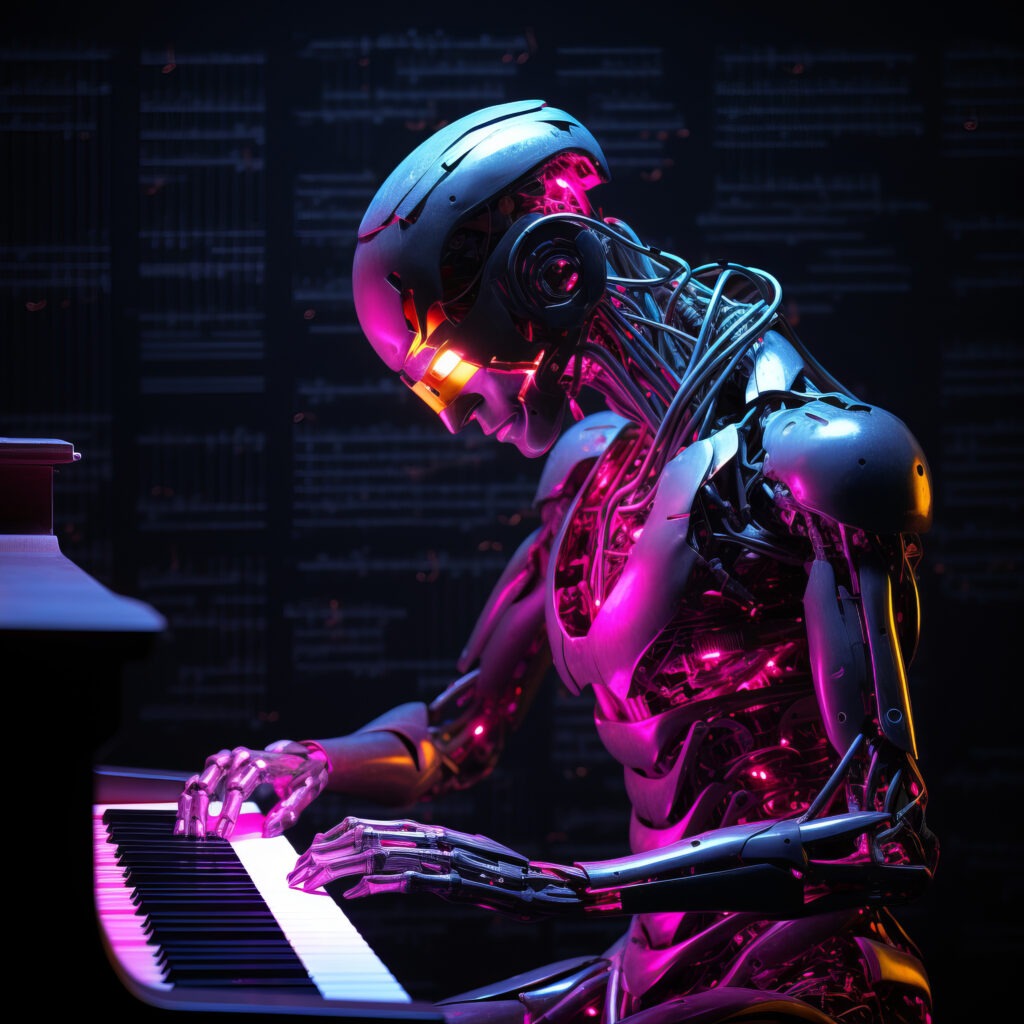
Generative AI – Machines creating text, art, and music autonomously
Generative AI– Machines creating text represents a fascinating and rapidly evolving field within artificial intelligence (AI) where machines don’t just analyze or interpret existing data, but create entirely new, original content that often mimics human creativity. This content can range from text, images, and audio to video, code, and even 3D models. How Generative AI Works: The Underlying Principles Generative AI models are built upon complex neural networks, particularly deep learning architectures. They are trained on vast datasets of existing content (e.g., millions of images, billions of lines of text, hours of music). During this training, the models learn the patterns, structures, styles, and underlying distributions of the data. Instead of simply memorizing the data, they learn how the data is composed. The core idea is to understand the “rules” of the data so well that they can then apply those rules to generate novel outputs. Key techniques involved include: Machines Creating Text: Generative AI excels at producing human-like text for a multitude of purposes: Machines Creating Art: Generative AI has transformed the artistic landscape, offering new tools for creators and even generating standalone artworks: Machines Creating Music: Generative AI is also making significant strides in music composition and production: Impact and Implications: Generative AI is not just a technological marvel; it has profound implications across industries: In summary, Generative AI is pushing the boundaries of what machines can do, transitioning them from mere data processors to genuine creators. It represents a significant leap forward in AI’s ability to interact with and augment human intelligence, promising to redefine industries and our relationship with technology. What is Generative AI – Machines creating text, art, and music autonomously? Generative AI is a groundbreaking subfield of Artificial Intelligence (AI) that focuses on creating entirely new, original content rather than just analyzing or processing existing data. Unlike traditional AI that might classify images or predict outcomes, generative AI actually produces novel outputs that can be indistinguishable from human-created content. Think of it this way: Key Characteristics of Generative AI: How Does It Create Content? (Simplified) While the underlying mechanisms are complex, involving deep learning and neural networks, here are some common approaches: Examples of What Generative AI Can Create Autonomously: In essence, Generative AI is a powerful tool that extends the capabilities of AI beyond analysis and prediction, enabling machines to participate directly in the creation of our digital world. Who is require Generative AI – Machines creating text, art, and music autonomously? Courtesy: AR Critic Generative AI, the technology behind machines autonomously creating text, art, and music, is rapidly becoming a necessity for a wide range of individuals, businesses, and sectors, particularly in a digitally advancing nation like India. It’s not just a novelty; it’s a powerful tool for boosting productivity, fostering innovation, and delivering highly personalized experiences. Here’s a breakdown of who requires Generative AI: 1. Content Creators and Marketers 2. Software Developers and IT Professionals 3. Creative Industries (Art, Music, Entertainment, Design) 4. Education and E-Learning 5. Customer Service and Support 6. Healthcare and Pharmaceuticals 7. Financial Services (BFSI) In essence, Generative AI is required by anyone looking to automate content creation, enhance human creativity, personalize experiences at scale, or gain a significant competitive advantage in a rapidly evolving digital landscape. India’s growing digital economy, skilled talent pool, and significant investment in AI research and development position it as a leader in adopting and leveraging generative AI across these diverse sectors. When is require Generative AI – Machines creating text, art, and music autonomously? Generative AI, in its capacity to autonomously create text, art, and music, is not “required” at a specific time of day or a particular date. Instead, its necessity arises when specific business, creative, or operational objectives demand capabilities that traditional methods cannot efficiently or effectively provide. Here’s a breakdown of “when” Generative AI is required, based on the problems it solves and the opportunities it unlocks: 1. When Content Creation Needs to Be Scaled Rapidly: 2. When Hyper-Personalization is a Strategic Imperative: 3. When Accelerating Design and Development Cycles is Crucial: 4. When Boosting Human Creativity and Overcoming Creative Blocks is Desired: 5. When Enhancing Customer Service Efficiency and Effectiveness is Key: 6. When Accessing Specialized Knowledge and Expertise is Limited: 7. When Cost Reduction in Content Production is a Priority: In essence, Generative AI becomes “required” whenever organizations face a need for speed, scale, personalization, innovation, or efficiency in content creation and problem-solving that cannot be met by traditional human-led or rule-based AI approaches alone. India, with its rapid digital adoption and ambitious growth targets, is seeing a burgeoning demand and rapid implementation of Generative AI across almost every sector. Where is require Generative AI – Machines creating text, art, and music autonomously? Generative AI, in its capability to autonomously create text, art, and music, is required across virtually every sector and geographical location where content creation, personalization, efficiency, and innovation are critical. Given India’s rapid digital transformation, its massive and diverse population, and its ambition to be a global technology leader, the adoption of Generative AI is particularly pronounced. Here’s a breakdown of “where” Generative AI is specifically required and seeing significant adoption in India: 1. Metropolitan and Tier 1 Cities (e.g., Bengaluru, Mumbai, Delhi-NCR, Chennai, Hyderabad, Pune) 2. Educational Institutions and E-learning Platforms 3. Manufacturing Hubs 4. Healthcare Sector 5. Remote Workforces and Decentralized Teams In essence, Generative AI is becoming a ubiquitous requirement across India’s digital landscape. Its ability to automate, personalize, and innovate content creation makes it indispensable in any organization or industry that relies on communication, creativity, or complex problem-solving. How is require Generative AI – Machines creating text, art, and music autonomously? Generative AI isn’t a “requirement” in the sense of a mandatory step or a fixed schedule. Instead, it becomes a strategic necessity or highly advantageous tool for organizations and individuals when they need to achieve specific outcomes that are difficult, expensive, or impossible to accomplish with traditional methods. The “how” Generative AI is required stems from its